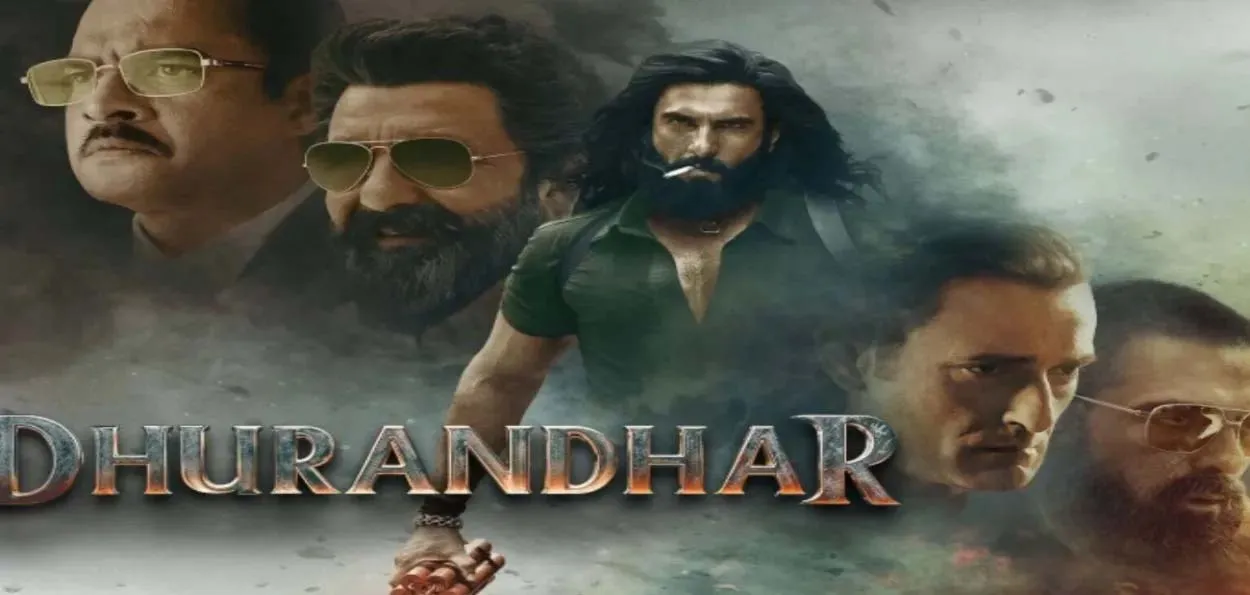
Dhruva is an action thriller film, part fact and part fiction
Awaze Bihar5 min read
Dr. Shaguftha Yasmin
The controversial Bollywood film Udharandhar is an action thriller film written and directed by Aditya Dhar which released on 5th December. It is jointly produced by Jyoti Des Pandey, Aditya Dhar and Lokesh Dhar under the banner of Jio Studios and Orbi Six Two Studios. Ranveer Singh, Akshay Khanna, R Madhavan, Arjun Rampal, Sanjay Dutt, Sara Arjun and Rakesh Bedi in the lead roles while the supporting cast includes Manu Gohal, Danish Pandoor, Soumya Tandon, Gaurav Ghera and Naveen Kaushik. The film is set in the infamous Lyari area of Karachi, and the film also allegedly involves the secret operations of the Indian intelligence agency, particularly those related to Operation Lyari. Ranveer Singh is playing the role of a 'secret agent' in this film. R. Madhavan's character is the National Security Adviser. Sanjay Dutt's role is that of Pakistani police officer Chaudhary Aslam Khan, while Akshay Khanna's role is that of gangster Rehman Daket. Arjun Rampal's role is that of Ilyas Kashmiri. This film, which is about four and a half hours long, is considered among the longest films of India in recent times. The first film of this two-part series has collected more than 100 crores in the first 3 days and is the best spy thriller as an action film. Lyari, which was once the cradle of poetry and literature and was known for lights, sports, football and hospitality, this town gave rise to an environment where the sound of gunshots was common for children. Football fields became graveyards for disposing of bodies. From the streets in the 70s and 80s where poor people wanted to educate their children but life did not allow them to go beyond crime due to compulsion. Rehman Dakit's childhood was like this. At the age of 13, he committed his first murder. As a young man, guilt started running in his veins. Rehman robbery had become a symbol of violence, fear and terror. To some he was a bloodthirsty don and a robber, to others Robin Hood and the Messiah. Incidents based on crime, poverty, politics and local heroism pushed Lyari into such a deep vortex of bloodshed and terrorism that several generations were ruined. Dharandhar is the story of a spy whose real name is Jaskirt Singh Rangi who is sent on a mission by intelligence to eliminate terrorists under the assumed name of Hamza Ali Mazari where he wins the trust of the terrorists and returns after killing them. Another strong character in the film is that of Rahman Dakit, played by Akshay Khanna. Due to his serious and passionate acting, he has played the role of a brutal and bloodthirsty don so well that according to the moviegoers and critics, he seems to dominate the lead role. A dance video of Akshay Khanna is becoming very viral. His dance scene was nowhere in the film. In this dance, Akshay was nowhere. In one scene, he had to enter a place with his colleagues, where some people were dancing, he saw people dancing and asked the director, can I dance? And as soon as Aditya got the signal, they started dancing. This dance was so charming that after the shooting, everyone got up and said, what have they done? It was choreographed by him himself but another video is also doing rounds on social media in which the famous actor of 70s and 80s and his father Vinod Khanna are dancing while attending an event in Pakistan in 1989. Cricketer Javed Miandad and actress Rekha can also be seen in it. Call it a coincidence that the dance steps of Akshay and his father are very similar. Whatever the case, this dance is rocking. Now as far as the comments of the film critics are concerned, mixed opinions have come out. Renuka Vivehare of The Times of India gave the film three and a half stars out of five and called the film a power-packed Karachi mafia thriller. Rishabh Suri of Hindustan Times gave the film three stars out of five and called it a long but rich spy drama. He praised Ranveer Singh, Akshay Khanna and director Aditya Dhar, but said that the film's subplots felt heavy at times. Deepa Gehlot of Rediff.com gave two and a half stars out of five and wrote, "Dharndhar lacks the depth and realism of a web-show detective story, nor the glitz of big cinema spy films." Pakistani journalist Sahar Baloch, while giving her unbiased opinion on this film, says that there has been a lot of talk about the Indian film Dharandhar, especially for its limited and superficial portrayal of Pakistani politics and the gang war of Karachi. But still there are some aspects which cannot be left without discussion. Firstly, Karachi's gang war is not a part of a dramatic fiction, but it was the reality of the past. Bullet had become a part of life in Lyari. People used to change paths. Children were more used to school closures and stepping into the wrong street was often a fateful decision. In the Indian film Dharandharm, the violence may be cinematic but here the blood was real, the bodies were real and the fear had become part of the collective memory. Secondly, why Pakistani filmmakers are not able to explain this fact? Why was it made a subject in India? On this, Sahar says, "There is such a difference between the past and the present of Karachi that a whole Netflix series can be made on it, but this character is still trapped in files and memories. We show love in movies, but why are we shying away from bringing the truth on the screen?" Thirdly, there is the story of a police officer like Chaudhary Aslam who was also known as an encounter specialist and represented the power of the state against terrorism and gang warfare. His rise, his power, his fear and the explosion that ended him at the hands of a militant organization, this can become a film script of not one series but many series. Who is the villain? Who is the hero? With whom the system and who was defeated in the end? These questions are still alive. The real question is, when will we make films on our country's themes? How long will we bring characters like Karachi's dust, Lyari's wounds and Chaudhary Aslam to the screen? Until we tell our own stories, the world will continue to see us through the narratives of others.