
National National
 National
 National
Finance Minister Sitharaman to present budget for 9th time, eyes on these key records
Awaze Bihar4 min read
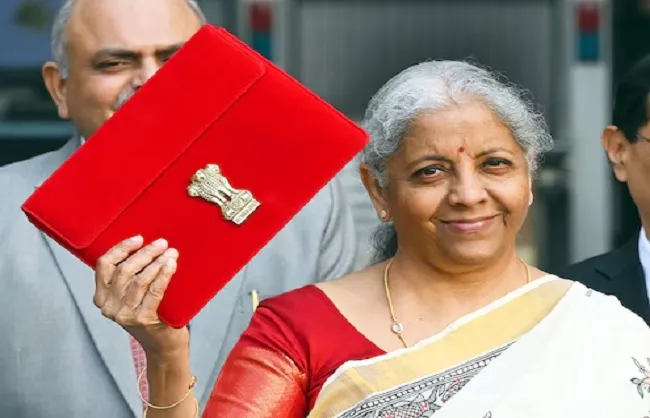
Finance Minister Nirmala Sitharaman is set to present the Union Budget on Sunday, February 1, for a record ninth time in a row. This time, all eyes will be on customs reforms, which are highly anticipated. In her first Union Budget in 2019, Sitharaman replaced the decades-old leather briefcase with a traditional 'Bahikhata' wrapped in a red cloth. Like the past four years, this year's budget will also be presented paperless.
Sitharaman is presenting the budget at a time when India has surpassed Japan to become the world's fourth-largest economy and is set to become the third-largest economy in the next two years. Along with this, the government is facing several severe economic challenges. Let's see what major challenges the Finance Minister will face while presenting the Union Budget.
Fiscal Deficit:
The difference between the government's total expenditure and revenue is called the fiscal deficit. It is likely to remain at 4.4% of GDP for the current financial year 2025-26. After achieving a target below 4.5% in the Union Budget, the market is now waiting for the correct figures for the reduction in debt-to-GDP ratio. As a result, the government is expected to announce a fiscal deficit of 4% for the next financial year 2026-27.
Capital Expenditure:
The government's planned capital expenditure for the current financial year 2025-26 has been set at Rs 11.2 lakh crore. Considering the caution shown by private investors, the government may maintain the infrastructure expenditure in the upcoming Union Budget and increase it by 10-15%. This amount is likely to exceed Rs 12 lakh crore.
Debt Framework:
The Finance Minister stated in the 2024-25 Budget speech that the objective of fiscal policy is to reduce the central government's debt as a percentage of GDP from the financial year 2026-27. The market will watch when the government plans to reduce the debt-to-GDP ratio to 60%. In 2024, this ratio was 85%, with the central government's share being 57%.
Borrowing:
The estimated total borrowing of the government for the financial year 2025-26 was Rs 14.80 lakh crore (approximately $1.48 trillion). The government borrows from the market to meet its fiscal deficit. These figures indicate the country's economic health and revenue collection situation.
Tax Revenue:
The Union Budget for the financial year 2025-26 set a target of Rs 42.70 lakh crore for total tax revenue, which is 11% higher than the previous year. Of this, Rs 25.20 lakh crore is estimated to come from direct taxes (income tax and corporate tax) and Rs 17.5 lakh crore from indirect taxes (customs, excise, and GST).
GST:
The GST revenue collection is likely to increase by 11% to Rs 11.78 lakh crore in the financial year 2025-26. An increase in revenue is expected after the rate cut from September 2025, so the estimates for the next financial year 2026-27 will be closely watched.
GDP Growth Rate:
According to the Economic Survey 2025-26, India's GDP growth rate is expected to remain between 6.8% and 7.2% in the financial year 2026-27, while the government has set a target to become a developed country by 2047. To achieve this goal, the country will need to maintain a consistent growth rate of 8% or more.
Rupee's Continuous Decline:
Despite the RBI's intervention, the Indian rupee is under pressure. On January 30, the rupee closed at 91.97, slightly higher, before touching a record low of 92.02 against the US dollar in the interbank foreign exchange market.
Farmers and Agricultural Production:
India's foodgrain production is estimated to be 3,577.3 lakh metric tons in 2023-24, which is 254.3 lakh metric tons higher than the previous agricultural year. However, the production of grains, corn, soybeans, and pulses is lower than the global average. According to experts, improving production, better seeds, modern technology, and irrigation are essential to increase farmers' income.
Sanitation and Air Pollution:
According to a January 2026 report by the Center for Research on Energy and Clean Air (CREA), 44% of Indian cities are plagued by chronic air pollution. In the national capital, New Delhi, the air quality remains in the "good" category for only 79 days out of 365 days in a year.
US High Tariff: The US has imposed a 50% tariff on Indian products, including a 25% basic tariff and an additional 25% tariff, due to India's purchase of cheap crude oil from Russia, which has significantly affected Indian exports.
Related News
RSS decides to increase focus on youth and women
Awaz E Bihar
Government hiding truth on clash with China in Arunachal, country should be given full information: Kharge
Awaz E Bihar
Efforts to take the opposition into confidence regarding the women's reservation and delimitation bills
Awaz E Bihar