Azam Khan granted major relief in money laundering case
The Congress leader also expressed concern over the growing trend of manufacturers reducing the quantity or weight of items in packets while keeping product prices unchanged. He said this practice is known as 'shrinkflation,' under which consumers have to pay the same or even higher prices to get less quantity of goods.
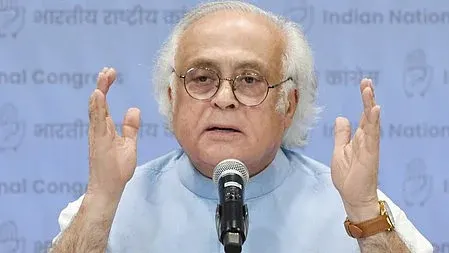
J. Ram Ramesh, General Secretary and In-charge of the Communications Department of the Congress party, on Wednesday targeted the Narendra Modi government over the continuous rise in prices of essential items, alleging that it is further increasing the financial difficulties of poor and middle-class families.
Demanding that Prime Minister Narendra Modi release a white paper on the inflation situation, Mr. Ramesh questioned the government about what strategy it is adopting to provide relief to common people struggling to control inflation and maintain balance in their monthly household budgets. In a stern statement on the social media platform X, he said that inflation has become the biggest concern for common families and the rising prices of daily-use items are continuously affecting people's purchasing power.
He pointed out that prices of various consumer goods, including mobile phones, televisions, biscuits, and salt, are also rising, while milk has already become expensive and the increasing prices of ghee and edible oils are also burdening consumers.
The Congress leader also expressed concern over the growing trend of manufacturers reducing the quantity or weight of items in packets while keeping product prices unchanged. He said this practice is known as 'shrinkflation,' under which consumers have to pay the same or even higher prices to get less quantity of goods.
Citing inflation data, Mr. Ramesh claimed that retail inflation rose to 6.09 percent and food inflation reached 8.94 percent in October. According to him, for the first time in the current Consumer Price Index (CPI) series, retail inflation has crossed the Reserve Bank of India's upper limit of six percent. He stated that the wholesale inflation rate is 12.29 percent, describing it as the highest level in the new Wholesale Price Index series launched with 2022-23 as the base year.
J. Ram Ramesh said that the pressure of inflation is not limited to household expenses but is also affecting business establishments due to the increase in raw material and production costs. He cited data indicating that the monthly expenses of 61 percent of families have increased by more than 20 percent compared to their previous expenses.
He warned that the increase in interest rates on loans could also exacerbate the difficulties of families already facing inflation. Citing the Reserve Bank's October monetary policy, he said that after a 0.25 percentage point increase in the repo rate, the rate has become 5.50 percent, resulting in several banks increasing interest rates on various loans, including home loans. He also mentioned the possibility of a further increase in the repo rate in December, stating that this could lead to an increase in monthly loan installments (EMIs).
According to Mr. Ramesh, poor and middle-class families are facing a double blow, as prices of essential items are rising on one hand and the burden of loan repayments is increasing on the other, while family incomes are under pressure. He said that the rising costs of food items, consumer products, and loans have made it difficult for common families to meet their daily financial obligations.
Satirising the Prime Minister, a Congress leader called him the country's "protection minister" and asked when the poor and middle‑class families will finally be able to bear this double burden of inflation. He demanded that the Prime Minister issue a white paper detailing the reasons for the continuous rise in prices and the government's concrete measures to curb inflation, and make this information public. Referring to the BJP's former promise of "better days," he asked when the public will finally have to endure "bad days" because of rising inflation. He concluded his statement with the slogan that the blow of inflation has been severe, now answer, Modi government.
It should be noted that rising prices in India have been a major political issue, as low‑income families spend a large portion of their earnings on food and other necessities. The increase in the cost of milk, edible oil, cooking essentials and everyday consumer goods affects families' savings and disposable income. For families repaying home loans and other debts, a rise in interest rates further intensifies financial pressure. Through this recent statement by J. Ram Ramesh, Congress has turned the issue of inflation and rising household expenses into a matter of political accountability for the Modi government, seeking clarification from the government on the gap between its promises and the economic situation of ordinary families.
admin