National
 National
 National
 National
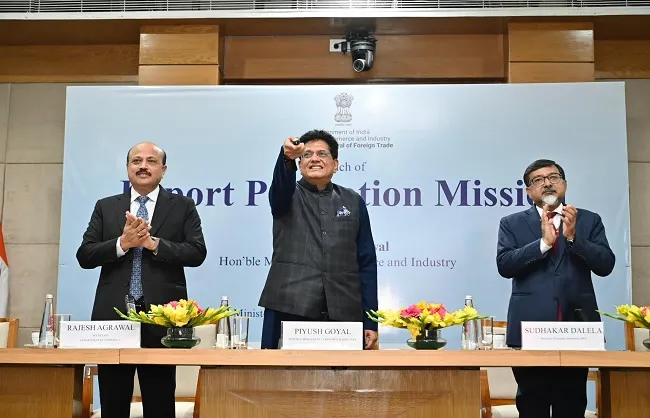
Piyush Goyal launched Export Promotion Mission to promote MSME products and strengthen global competitiveness
Awaze Bihar5 min read
Union Minister of Commerce and Industry Piyush Goyal today launched seven additional initiatives under the Export Promotion Mission (EPM), a major initiative of the Department of Commerce, aimed at empowering Micro, Small and Medium Enterprises (MSMEs) in the global market. These initiatives are designed to address key challenges faced by Indian exporters, promote broad-based and inclusive export growth, and strengthen India's position as a competitive exporting nation globally. Commerce Secretary Rajesh Agarwal was also present on the occasion.
Addressing the participants on the occasion of World Social Justice Day, Mr. Goyal said that social justice means reaching out to the person at the bottom of the pyramid. He emphasized that inclusive growth, empowering backward classes, and providing opportunities to those left behind in India's rapid transformation are essential for achieving true social justice.
The Minister highlighted India's growing leadership in emerging technologies and global partnerships. Referring to the recently concluded AI Summit, he commended Prime Minister Narendra Modi and the concerned Ministers for placing India at the center of global discourse on artificial intelligence and future technologies. He said that advancements in artificial intelligence, machine learning, quantum computing, data centers, and the country's large language models will create significant opportunities for India's youth and energize investments across all sectors.
Mr. Goyal stressed that India's expanding network of Free Trade Agreements (FTAs) has significantly increased market access for Indian exporters. He said that nearly 70% of global GDP and two-thirds of global trade are now accessible to India through nine concluded FTAs, including the first tranche of the bilateral trade agreement with the US. These agreements provide preferential access to 38 developed and emerging economies.
The Minister noted that India is now confidently engaging with developed economies, leveraging competitive strengths in select sectors while protecting sensitive sectors. Since 2022, India has accelerated trade engagements, enhanced participation in goods, services, and investments, reduced compliance burdens, decriminalized several laws, and improved the ease of doing business.
He also referred to India's successful hosting of the G20 Summit in multiple cities, showcasing the country's diversity and economic capabilities. Emphasizing that the benefits of global trade should reach every MSME, startup, and business person, Mr. Goyal said that the Export Promotion Mission aims to promote new products, services, and exporters, while enabling Indian businesses to access new markets.
He said that India has recorded double-digit growth in merchandise exports in the first half of February, reflecting strong market confidence and industry participation. The Mission aims to simplify procedures for MSMEs, strengthen credit access, improve quality standards, assist in compliance with international regulations, and enhance global logistics and warehousing infrastructure.
Initiatives like the Bharat Mart in Dubai aim to provide Indian exporters with strategic access to markets in the GCC, Africa, Central Asia, and Europe. The Export Promotion Mission adopts a comprehensive ecosystem approach by converging financial and ecosystem support through a unified and digital monitoring framework.
Emerging export opportunities support - This initiative provides exporters with various shared risk and credit instruments to access new or high-risk markets. These mechanisms are designed to strengthen exporters' confidence and cash flow.
In addition, the following initiatives were launched under the Niryaat Disha: Trade Regulations, Accreditation, and Compliance Enablement (TRACE) - TRACE assists exporters in meeting international testing, inspection, certification, and other compliance requirements. Positive list under 60% and priority positive list under 75% partial reimbursement will be provided for eligible testing, inspection, and certification costs, with a maximum annual limit of Rs 25 lakh per IEC.
Logistics, Overseas Warehouse, and Supply and Demand Fulfillment Infrastructure Facility (FLOWS) - FLOWS provides exporters with access to overseas warehouses and supply and demand fulfillment infrastructure, including e-commerce export hubs integrated with global distribution networks. Assistance up to 30% of the project cost will be provided, which is for a maximum of three years and as per the prescribed limits and MSME participation criteria.
Transportation and Logistics for MSMEs (LIFE) - LIFE reduces geographical disabilities for exporters in districts with low export intensity. Partial reimbursement of up to 30% of eligible transportation costs will be provided, with a maximum annual limit of Rs 20 per IEC.
Integrated Support for Trade Facilitation and Information (INSIGHT) - INSIGHT strengthens the trade facilitation and information system, exporter capacity building, district and cluster-level facilitation, and development of trade information systems under the Districts as Export Hubs initiative. Financial assistance up to 50% of the project cost will be provided, while central and state government agencies and Indian Missions' proposals will be eligible for up to 100% assistance, as per the prescribed limits.
Through these converged financial and ecosystem initiatives, the government aims to reduce the cost of capital, diversify trade finance instruments, enhance compliance readiness, remove logistics bottlenecks, and strengthen MSME integration into foreign markets.
Initiatives - market access support, pre- and post-shipment export credit interest subvention, and export credit guarantee support are already in place. With this launch, 10 out of the 11 proposed initiatives under the EPM are now operational.
Representatives from state governments, export promotion councils, and industry associations, including FIEO, EPC, GJEPC, CII, FICCI, PHDCCI, ASSOCHAM, and NASSCOM, welcomed the initiative and expressed support for its effective implementation.
The session emphasized that AI leadership will be shaped not only by access to computing but also by a strong research ecosystem, startup participation, market articulation, and organizational readiness to transform infrastructure through innovation. As India enhances its autonomous computing capabilities and expands access through national platforms, the next phase will depend on how effectively these capabilities are translated into real-world deployments and globally competitive solutions.
Related News
RSS decides to increase focus on youth and women
Awaz E Bihar
Government hiding truth on clash with China in Arunachal, country should be given full information: Kharge
Awaz E Bihar
Efforts to take the opposition into confidence regarding the women's reservation and delimitation bills
Awaz E Bihar