BJP appoints 7 national vice presidents and 3 national general secretaries in OBC morcha
Maintaining peace and ensuring development in the border state are both equally essential. Arunachal Pradesh's international borders stretch to a total of 1,863 km with three countries, including 1,126 km with Tibet-China, 520 km with Myanmar, and 217 km with Bhutan.
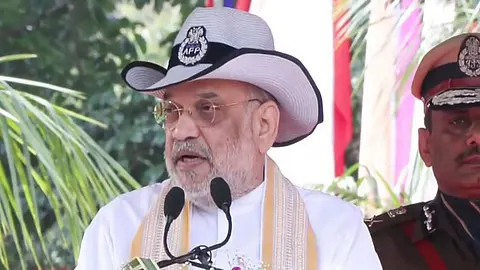
Union Home Minister Amit Shah on Saturday described the proposed 11,200 MW 'Siang Upper Multipurpose Project (SU MP)' as extremely important for the development of Arunachal Pradesh and the country's energy security. Mr. Shah assured the people of the Siang region, particularly the Adivasi community, that the central government would address their concerns through dialogue and would not compromise on their cultural identity, rights, or interests. Addressing a public rally after honouring the Arunachal Pradesh Police with the prestigious 'Presidents Police Colours' at the Police Training Centre (PTC) in Bandur Diwa, Mr. Shah said that this major hydropower project would increase India's power generation capacity and play a vital role in the state's economic growth and revenue. He called the project crucial for the future of Arunachal Pradesh, stating that it would strengthen the country's energy infrastructure and boost the state's revenue.
Regarding the proposed project and the concerns of the people in the Siang region, the Home Minister said that the central government would engage in positive dialogue and consultation with the affected communities to build trust and find mutually acceptable solutions. He assured the people of the Siang region, especially the Adivasi community, that their cultural identity, traditional rights, and interests would be fully protected. He said, "I want to assure my brothers and sisters in Siang that we will engage in positive and constructive dialogue with you to build your confidence regarding this project. Only through dialogue can we address your concerns. You have no reason to worry." Reiterating that the government respects the traditions and cultural heritage of the Adivasi community, Mr. Shah said that no compromise would be made on the identity and rights of local inhabitants in the name of development. He said, "We will find a way forward that prioritises your culture and everything associated with it. Please establish contact and dialogue with the state government and the Home Department. This project is for the future and development of the youth of Arunachal, and we will move forward only with your confidence. The central government will not compromise on the rights and identity of the people." Mr. Shah assured that the government would provide one of the most attractive rehabilitation and resettlement packages in the country for those affected by the project. These remarks came amid opposition and concerns raised by some people in the Siang region over the proposed large-scale project, where local organisations and communities have expressed worry about its potential social, environmental, and cultural impacts. Mr. Shah also emphasised the strategic importance of Arunachal Pradesh, stating that due to the state's sensitive geographical position, its security is extremely vital for the country's safety.
He said that maintaining peace and ensuring development in this border state are both equally essential. Arunachal Pradesh's international borders stretch to a total of 1,863 km with three countries, including 1,126 km with Tibet-China, 520 km with Myanmar, and 217 km with Bhutan.
Pointing to the growing threat of drug smuggling, he described Arunachal Pradesh as a part of the drug smuggling route and emphasized the need to remain constantly vigilant and take effective action against drug networks. He praised the Arunachal police for their alertness and efforts in tackling drug‑related activities.
Earlier, addressing the ceremony, Chief Minister Pema Khandu called the conferring of the 'President's Police Colour' a moment of utmost significance in Arunachal Pradesh's history. He said it was one of the highest institutional honours bestowed on any police force in the country. Thanking President of the Republic of Darupdi Mr. Mormo and Mr. Shah for the award, Khandu congratulated all personnel of the Arunachal Pradesh Police, whether currently serving or retired, on this achievement.
Recalling the evolutionary journey of the state police force, the Chief Minister noted that initially Arunachal Pradesh relied on Assam rifles for its security. The Arunachal Pradesh Police was established in 1971 during the tenure of the North East Frontier Agency (NEFA) and initially operated from its headquarters in Shillong. Later, in 1973, a police training centre was set up at Bandar Deva.
Mr. Khandu said that from modest beginnings the force has expanded considerably over the decades. It now comprises 4 ranges, 29 police stations, 5 battalions of the Arunachal Pradesh Police, 5 battalions of the India Reserve Police and roughly 16,500 personnel.
During his three‑day visit to Arunachal Pradesh, Mr. Shah will later hold a review meeting with senior officials of the state government at Lok Bhun. The meetings will discuss development projects, infrastructure expansion, internal security and the development of border areas. He will attend a programme on Sunday at the Dorji Khandu State Convention Centre, where he will launch the 'Arunachal Pradesh Cooperation Vision Document 2047', present 'Cooperation Awards' and inaugurate the 'Sars Mela'. Before departing for New Delhi, he will also inaugurate the permanent premises of the 12th Battalion of the National Disaster Response Force (NDRF) in Holongi.
admin