
Sports
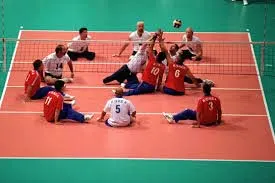
Sitting Volleyball: An exciting and entertaining game for physically disabled players
Awaze Bihar4 min read
New Delhi: Setting volleyball is the most popular form of para-volleyball, since it was included in the Paralympic Games after Arnhem in 1980. It is a universal sport that can be played by any disabled player. All athletes with physical disabilities are eligible to compete internationally, provided they pass the classification process. Many athletes are athletes with disabilities. In addition, two players from each team may have a 'minimal disability', meaning that their disability may be minimally apparent but may prevent them from competing in a traditional version of the game.
Sitting volleyball was invented in the late nineteenth century by William G., director of physical education in Holyoke, Massachusetts, USA. Inspired by tennis and basketball, Morgan developed volleyball and incorporated it into his sports and exercise program as a recreational sport.
Sitting volleyball was originally a rehabilitation exercise for wounded soldiers. It first appeared in the Netherlands in 1956 and has now become an integral part of the Paralympic Games. The game combines volleyball with the German game sitzball, in which players sit and play volleyball. The first Sitting Volleyball World Championship, for men only, was held in Dalton, Netherlands in 1983. The first Women's Sitting Volleyball World Championship was held in Bottrop, Germany in 1994. A standing demonstration volleyball event was held at the 1976 Paralympic Games, designed for athletes with limited mobility. In the next Games in 1980, both sitting and standing volleyball were added as medal events.
Sitting volleyball was first introduced to the Paralympic program at the 1980 Games in the Netherlands, while standing volleyball was first introduced at the 1976 Paralympic Games in Toronto, Ontario, Canada. Paralympic volleyball is divided into two major disciplines: setting and standing. However, for the Athens Games in 2004, only sitting volleyball was on the Paralympic program. Athens also hosted the first Paralympic competition for women's set volleyball. The basic rules of Paralympic volleyball are the same as those of volleyball, with some modifications to accommodate different disabilities.
In setting volleyball, the net is about 3.5 feet high, and the court is six by ten meters with a two-meter attack line. Each player's position is determined and controlled by the position of their hips. A player may serve, attack and cross the center line, provided the player does not interfere with an opposing player. The classification determines which players are eligible to compete and how athletes are grouped to compete. If an athlete has a Paralympic qualifying disability, the athlete may be eligible for classification placement. Once an athlete is ready to compete at the regional or national level.
The post-London 2012 Games slide was founded by Matt Roger to promote and grow the sport globally. Eight men's and eight women's teams competed in the 2020 Tokyo Paralympic Games. In sitting or sitting volleyball, the length and width of the net are kept at 23 feet and 2 feet 7 inches respectively. Height is 1.15 meters for men and 1.05 meters for women. The court is 10 by 6 meters with an attack line of 2 meters. The rules are the same as in basic volleyball, with the exception that players must have at least one hip in contact with the floor whenever they make contact with the ball.
A team for a match can consist of a maximum of 14 players who have 'Verified' sports category status or 'Review' sports category status at international level, including a maximum of two players who can be classified.
Athletes with disabilities are athletes who are eligible to compete in sitting volleyball with amputations of hands or feet, spinal cord injury, cerebral palsy, traumatic brain injury, and are classified into two categories based on disability. Only two VS players are allowed on the court at a time. This is done to keep the competition fair between rival teams. The rest of the team is classified as VS A players.
In 1980, 2 events were held in Arnhem, Netherlands, in which 11 countries participated. Subsequently, 2 events were held in New York, USA in the year 1984 in which 13 countries participated. Year 1988 Seoul, South Korea - In 2 competitions, 13 countries with 158 athletes and all male athletes participated in this event. 1992 Barcelona, Spain - 2 events, 17 countries and 211 athletes, also all men. In 1996, two events were held in the United States in which 225 athletes from 18 countries, all male, participated. This was followed by 2000 Sydney, Australia - 2 events, 17 countries and 233 athletes, all male. Year 2004 Athens, Greece - 2 events, 12 countries and 157 athletes participated with 92 male and 65 female athletes. 2008 Beijing, China - 2 events, 14 countries and 181 athletes, 96 men and 85 women. In 2012, 2 events were organized in London, United Kingdom, involving 15 countries and 197 athletes, 109 male and 88 female athletes participated.