RSS decides to increase focus on youth and women


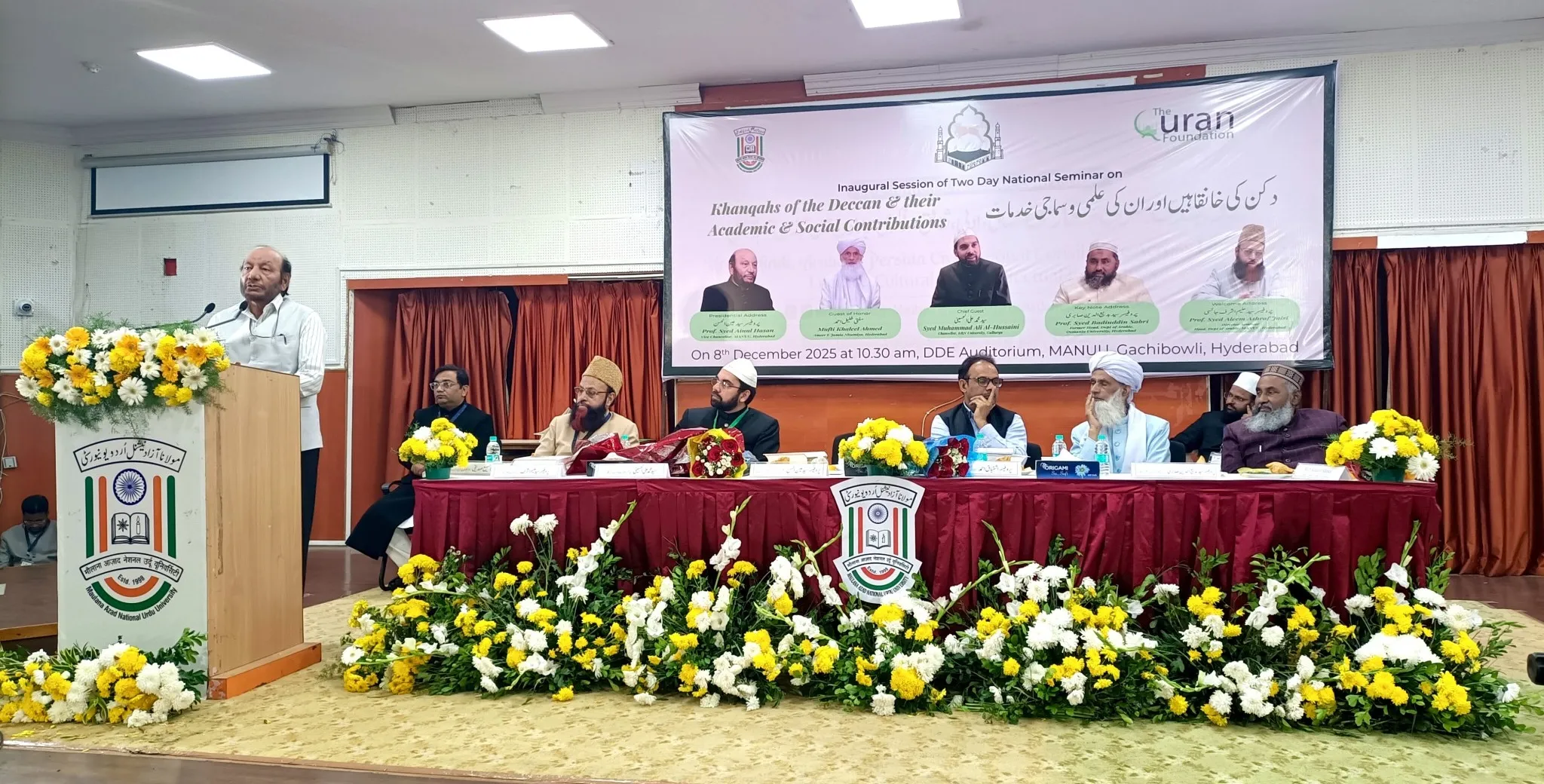
Experts have acknowledged that after conducting research in various modern sciences, the subjects mentioned are also found in the Holy Quran. These views were expressed by Mufti Khalil Ahmed, Amir of Jamia Nizamia, Hyderabad, while addressing the inaugural session of a two-day national seminar held at Maulana Azad National Urdu University. The seminar on the topic "Dakkan's Khanqahs and their academic and social services" is being organized in collaboration with the Department of Arabic and the Center for Urdu Culture Studies, Manuu and The Quran Foundation, Hyderabad. The inaugural session was presided over by Professor Syed Ainul Hasan, Vice Chancellor.
Mufti Khalil Ahmed further said that in every era, scholars have achieved expertise and excellence in various sciences and subjects, and the Sufis have made purification of the soul and benevolence their field of action. According to him, Sufism is nothing but ethics, and ethics are recognized by humanity. If someone lacks humanity, they are far from humanity and ethics. He said that the first school of Sufism was the platform of the Companions of the Bench, where training and purification took place.
Syed Muhammad Ali Al-Hasani, Sajjada Nashin of the Dargah of Hazrat Khwaja Bandanawaz and Chairman of the Karnataka Board of Auqaf, also addressed the two-day conference and emphasized the revival of the Khanqah system. He said that in the past, Khanqahs were not only places of worship but also centers of training, schools, public service, and spiritual training. Syed Muhammad Ali Al-Hasani said that if this system of service, worship, and training is re-established, the spirit of the Khanqah system can be restored.
In his presidential address, Vice Chancellor Professor Syed Ainul Hasan said that Sufism is a journey towards the better, which requires tolerance, patience, and perseverance. He said that in the present era, all the challenges facing humanity can be easily solved if we restore the Khanqah system to its original spirit. He said that one of the main objectives of organizing the seminar on the topic of Dakkan's Khanqahs at Maulana Azad National Urdu University is to promote research on this topic at the university level and to give confidence to researchers.
Dr. Badiuddin Maheri, former Head of the Department of Arabic, Osmania University, delivered the keynote address in the first session of the conference. He said that Karnataka, Maharashtra, Telangana, and Andhra Pradesh have been part of Dakkan, where there is a long and glorious history of the Khanqah system. However, formal research on this topic is still pending. He said that the word Khanqah means a place to eat, and in Khanqahs, public service is given the most importance while arranging Langar. A complete system was in place in Khanqahs for the spiritual training of the people, along with eliminating public hunger.
Professor Ishtiaq Ahmed, Registrar, also addressed the conference. He reminisced about his visits to several Khanqahs in Dakkan. The Registrar expressed pleasure that all the research papers presented during the seminar are being published in book form and also in PDF format. It is worth noting that all the research papers presented at the seminar are in PDF format, with 89 papers in Urdu and 14 papers in Hindi and English.
Initially, in the welcome address, Professor Aleem Ashraf Jaisi, Dean, Student Welfare, explained the objectives of the seminar and thanked the Sheikh-ul-Jamia for patronizing the seminar. He said that the seminar will cover the achievements of the loved ones of God. According to him, in Khanqahs, the purification and training of the servants of God have been carried out through knowledge and action.
Professor Muhammad Abdul Sami Siddiqui, Director, CPDUMT, conducted the proceedings. The session began with the recitation of the Holy Quran by Dr. Abdul Aleem, Assistant Professor, CDO.