National
 National
 National
 National
Urdu is a living language of India and is playing a vital role in the country's development: Dr Shams Iqbal
Awaze Bihar6 min read
On the third day of the International Urdu Conference organized by the National Council for Promotion of Urdu Language, New Delhi, three important technical sessions and a mushaira were held under the title "Multilingual India and Urdu Language and Culture". In these three sessions, various scholars expressed their views on the linguistic, cultural, literary, and civilizational connections of Urdu with other languages. The session presidents, while terming the theme of the International Urdu Conference as a need of the time, congratulated the National Urdu Council and its Director, and considered it a milestone in the promotion and dissemination of Urdu.
In the first session, Dr. Khwaja Iftikhar Ahmed presided, while Professor Shafeeq Qidwai and Professor Ravi Tek Chandani participated as guests of honor. Professor Shambhunath Tiwari, Professor Intekhab Hamid, Khawar Naqvi, Shabir Ahmed, and Ms. Asma Today presented their papers. The session was moderated by Ms. Nahan Rabab. In his presidential address, Dr. Khwaja Iftikhar Ahmed said that India is a root with many branches, and it is our responsibility to keep each branch green. He also emphasized the need to use simple words to make Urdu more accessible and widespread. Urdu is not just a Muslim name, but an Indian name. Such conferences promote harmony in the country. Language also plays an important role in interfaith harmony.
The first guest of honor, Professor Ravi Tek Chandani, spoke about the linguistic relationship between Sindhi and Urdu and also shed light on the principles and regulations for the promotion of languages. The second guest of honor, Professor Shafeeq Qidwai, pointed to various aspects of the conference theme and also informed about the benefits and dangers of multilingualism. He mentioned the thoughts and ideas of Pannani, Anand Wardhan, and Abhinav Gupta on Urdu language and literature.
Ms. Asma Today presented her paper on the linguistic relationship between Telugu and Urdu, and identified several words that are prevalent in both languages with minor changes. Another paper presenter, Khawar Naqvi, presented his paper in the context of the Indian knowledge system and considered Urdu translations important for connecting with different cultures. Shabir Ahmed presented a paper titled "National Heritage and Culture in the Mirror of Urdu Translations" and drew attention to several important points. Professor Intekhab Hamid presented his paper on the subject of language contingency logic and results, and considered the conference themes to be in line with the National Education Policy 2020. Professor Shambhunath Tiwari presented his thoughts on Urdu in relation to Indian culture and civilization, and described the mixture of different cultures as India's greatest beauty.
In the second session, Professor Syed Aeinul Hassan presided, and Dr. Jameel Akhtar participated as a guest of honor. The paper presenters included Professor Mushataq Alam Qadri, Professor Jalal Al-Hafnawi, Dr. Tashiana Shmatli, Dr. Allen Desoulieres, and Dr. Sufina Begum. The session was moderated by Dr. Nisar Ahmed Khan. In his presidential address, Professor Aeinul Hassan shed light on the papers of all the paper presenters. He said that Urdu does not need to be underestimated, as it has absorbed various sciences and arts. He also pointed to the promotion of Urdu through its linguistic relationships with other languages.
Guest of honor Dr. Jameel Akhtar expressed his views on linguistic relationships, saying that it is necessary to discuss the effects of Urdu on other languages. Dr. Sufina Begum presented a paper titled "Two Translations of Rabindranath Tagore's Stories". Dr. Tashiana Shmatli from Mauritius expressed her thoughts on the linguistic relationship between Urdu and the Mauritian language and explored the aspects of harmony between the two. Professor Mushataq Alam Qadri presented a paper on the impact of Urdu language on Gujarati ghazal, and presented several examples. Professor Jalal Al-Hafnawi's (Egypt) paper was related to the linguistic relationship between Urdu and Arabic, and he also spoke about Arabic compounds and idioms prevalent in Urdu. Dr. Allen Desoulieres (France) spoke on the topic "Sufism and Concept, Spanish and Urdu" and also presented some translated samples.
The third session was presided over by Professor Qudoos Javed, and Professor Ejaz Ali Arshad and Professor Arziya Karim participated as guests of honor. Professor Heinz Werner and Muhammad Seifi Umri presented their papers. The session was moderated by Dr. Ahsan Ayoobi. In his presidential address, Professor Qudoos Javed said that India is not just a geographical region, but a name of multiple cultures. Our shared culture is rooted in the Vedic era. He said that the identity of Urdu is established through its symbols, metaphors, and allusions. A word is not just a word, but a picture, a sound, and a representative of a long history and culture.
Guest of honor Professor Arziya Karim said that those who know other languages should also think about representing Urdu language and culture, which will lead to a two-way process of language promotion. The second guest of honor, Professor Ejaz Ali Arshad, said that accepting words and effects from other languages is beneficial for the development of any language. He considered Urdu as the best example of linguistic democracy. Paper presenter Muhammad Seifi Umri presented his paper on the literary connection and sharing between Urdu and Tamil, and shed light on the mystical and aesthetic harmony between the two. Professor Heinz Werner (Sweden) spoke about the relationship between Urdu language and culture in multilingual India, and identified the mutual interactions and effects of different languages.
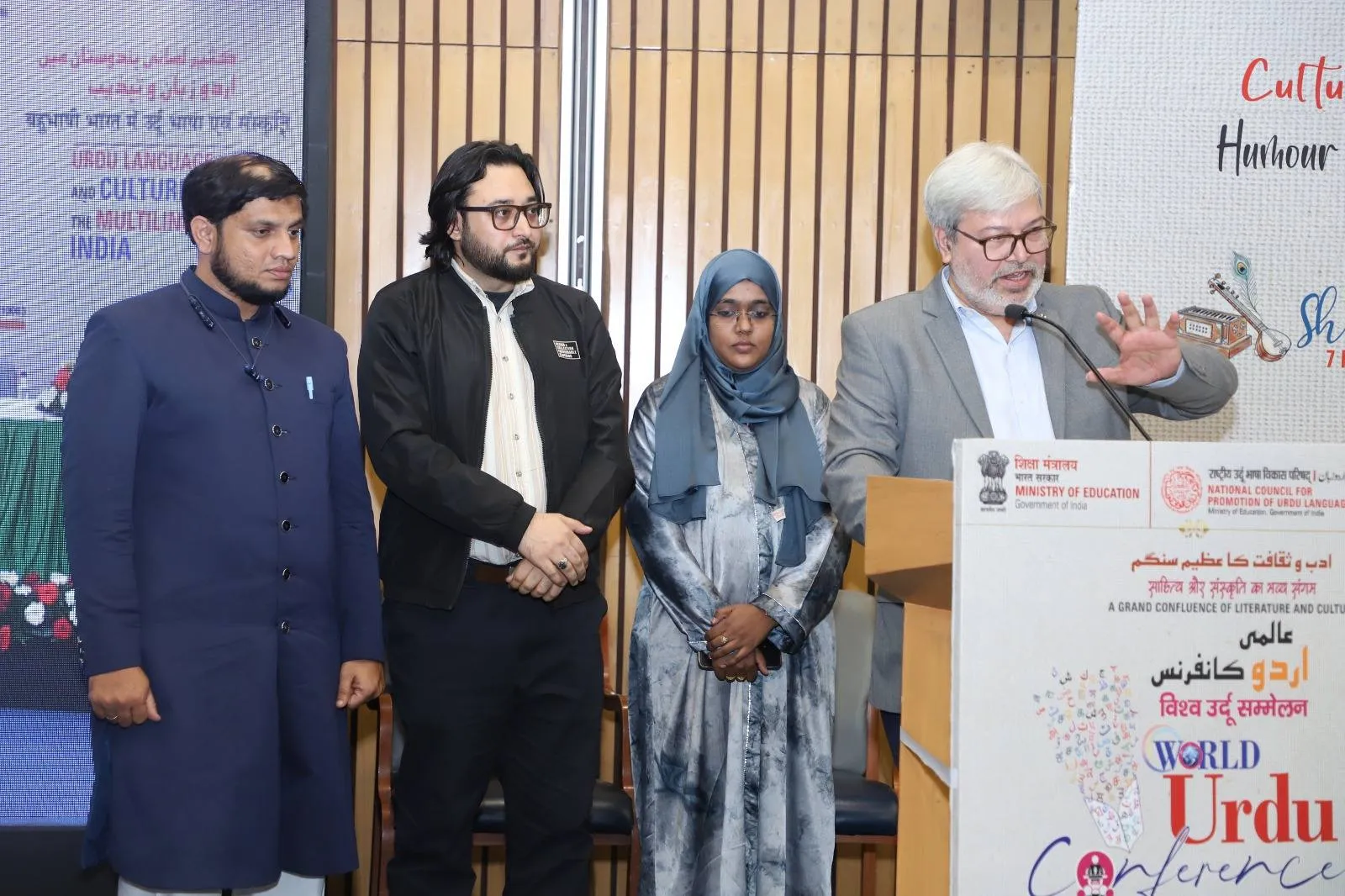
The three-day International Urdu Conference concluded with the address of the Director of the National Council for Promotion of Urdu Language, Dr. Mohammad Shams Iqbal. He conveyed the message of Prime Minister Shri Narendra Modi and expressed his thoughts, saying that the conference had representation from various regions. Regarding Urdu language and culture in multilingual India, he said that we do not need to be confined to one circle. The representation of Urdu from different regions indicates that it has the inclusion of various cultures. There should be a continuous exchange of literature between languages. Urdu is present in every province, every district, and every place. To make Urdu more widespread, we need to move beyond the grip of pronunciation and recitation. It is a living language of India and is contributing to the country's development. He further said that just as we are happy to see Urdu words in other languages, we should also be generous in using words from other languages in Urdu. The National Urdu Council has recently involved about 700 people in its activities and encouraged the new generation. In this regard, he congratulated the three young scholars selected for the International Urdu Conference, Muhammad Firoz Ahmed (Ladakh), Asma Today (Telangana), and Muhammad Seifi Umri (Tamil Nadu), and thanked all the guests, paper presenters, members, and participants from within and outside the country.
At the conclusion of the conference, a beautiful mushaira was also organized, which was presided over by senior poet Chandra Bhan Khayal. The mushaira was attended by poets including Professor Shahpar Rasool, Dr. Popular Merathi, Shakeel Jamali, Professor Saraj Ajmali, Numan Shauq, Afzal Manglauri, Dr. Majid Deobandi, Muzaffar Abdali, Manish Shukla, and Dr. Qamar Sarwar, who presented their poetry. The mushaira was moderated by Moin Shadab, and the introduction and welcome were presented by Muhammad Ikram.
Related News
RSS decides to increase focus on youth and women
Awaz E Bihar
Government hiding truth on clash with China in Arunachal, country should be given full information: Kharge
Awaz E Bihar
Efforts to take the opposition into confidence regarding the women's reservation and delimitation bills
Awaz E Bihar