RSS decides to increase focus on youth and women

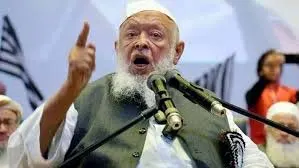
Today, in the backdrop of the discussion on Vande Mataram in Parliament, President of Jamiat Ulama-e-Hind, Maulana Arshad Madani, said that we do not object to anyone reciting Vande Mataram, but we want to clarify once again that a Muslim only worships one God and cannot associate anyone else with Him in his worship. In a statement issued here today, he further said that the contents of the Vande Matram poem are based on polytheistic beliefs and ideas, especially in its four verses, where the country is likened to 'Durga Mata' and words are used to worship it, which is against the basic faith and belief of any Muslim. The Constitution of India provides religious freedom (Article 25) and freedom of expression (Article 19) to every citizen. Under these provisions, no citizen can be forced to adopt any slogan, song, or ideology that is against his religious beliefs and sentiments.
Maulana Madani also said that the Supreme Court has also ruled that no citizen can be forced to sing the national anthem or any such song that is against his religious beliefs. He said that love for the country is one thing and worshiping it is another. Muslims do not need anyone's certificate to prove their love for the country. The unparalleled sacrifices of Muslims and the elders of Jamiat Ulama-e-Hind in the freedom struggle and their efforts against the division of the country are evident, and their struggle for the unity and security of the country after independence can never be forgotten. We have always said that patriotism is related to the loyalty of the heart and action, not to slogan-raising.
Maulana Madani said in the context of Vande Matram that historical records are clear that on October 26, 1937, Rabindranath Tagore advised Pandit Jawaharlal Nehru in a letter that only the first two stanzas of Vande Matram should be accepted as a national song, as the remaining verses are in conflict with the beliefs of monotheistic religions. This was the basis on which the Congress Working Committee decided on October 29, 1937, to approve only two stanzas as a national song. Therefore, using Tagore's name incorrectly to forcibly impose this poem or to sing it in its entirety is not only an attempt to distort historical facts but also an insult to the concept of national unity and Guru Tagore himself. It is also regrettable that people link it to the division of India, whereas Rabindranath Tagore's advice was for national unity.
He emphasized that the debate on Vande Matram should be within the framework of respect for religious beliefs and constitutional freedom, rather than in the style of political blame-shifting. Jamiat Ulama-e-Hind appeals to all national leaders not to use such sensitive religious and historical issues for political gain, but to fulfill their constitutional responsibility to promote mutual respect, tolerance, and unity in the country. "Vande Matram" is an excerpt from Bankim Chandra Chatterjee's novel "Anand Math". Many of its lines are against the religious principles of Islam, which is why Muslims avoid singing this song. The full meaning of "Vande Matram" is "Mother, I worship you." This clearly indicates that this song was sung in praise of the Hindu goddess Durga, not Mother India. Vande Matram was written in praise of Durga.
Maulana Madani said that Islam is a monotheistic religion that worships one God, who has no partner, has always been and will always be, and has power over everything. Worshiping any country or mother is in conflict with this monotheistic principle. The song "Vande Matram" demands bowing down to the mother and worshiping her, while Islam prohibits bowing down to anyone or worshiping anyone other than God. We believe in one God, we do not consider anyone else as our deity, and we do not prostrate before anyone, so we cannot accept it under any circumstances. We will die for Islam and live for Islam, God willing.
Maulana Madani asked if there is no other issue in the interest of the country and the nation, apart from these controversial issues, that can be discussed in Parliament. He said that the reports being heard about the country's economic and financial situation are extremely alarming, and if attention is not paid to it immediately, the country may face a major economic crisis, but no discussion is held on this because such discussions do not yield votes, and nor can communal polarization be created in the country. Today, it has become a tried and tested formula to win elections.