
National
 National
 National
 National
A rare glimpse of army's war strategy on Kirtiwar Path 'Battle Array'
Awaze Bihar2 min read
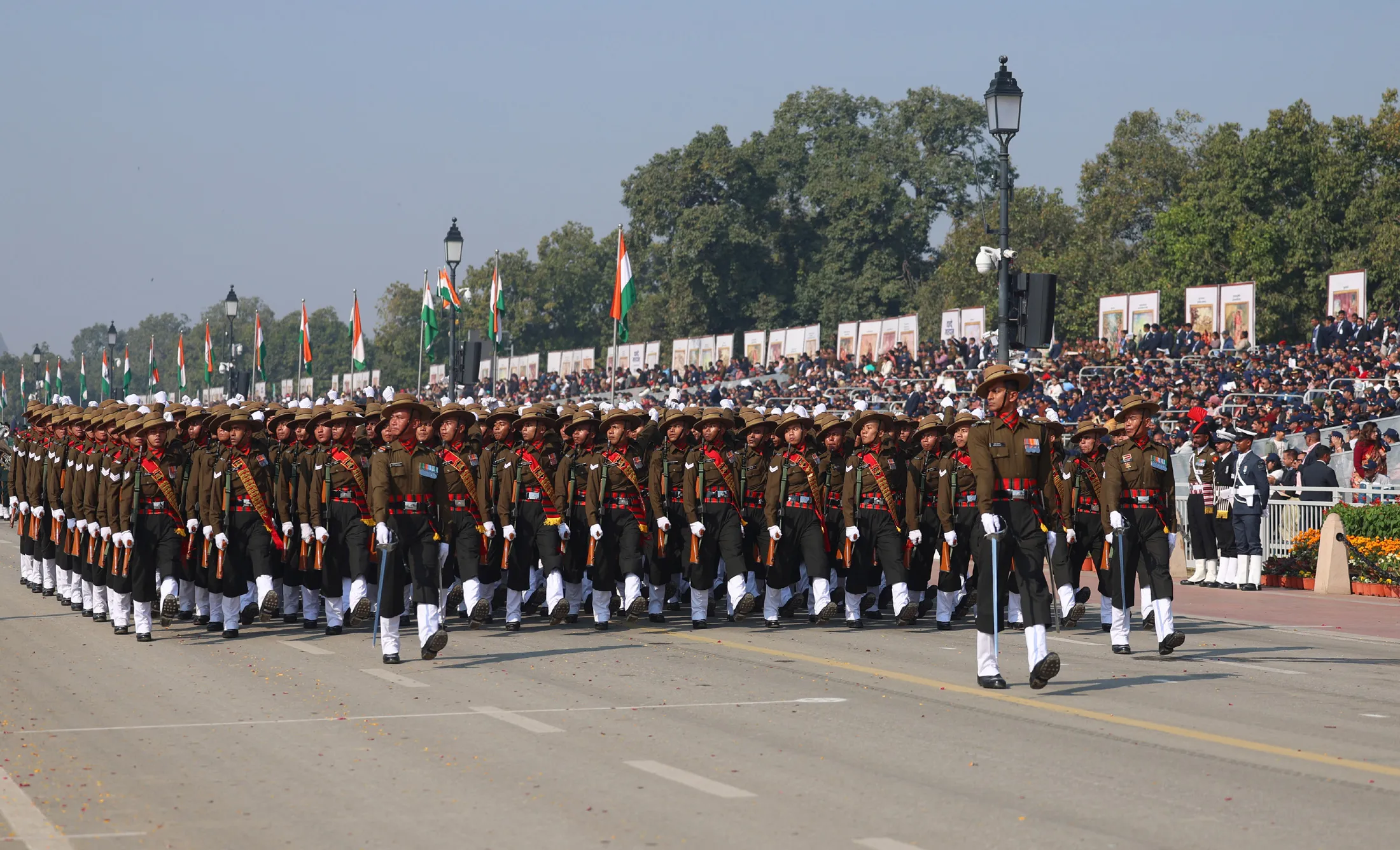
On the occasion of the Republic Day parade, a rare glimpse of the Indian Army's battlefield strategy, 'Battle Array', was seen for the first time on Kartavya Path. The Indian Army showcased its robust and modern form, which is fully prepared for any kind of war in the future.
During the 77th Republic Day celebrations on Monday, the Indian Army celebrated the success of Operation Sandur against the elements responsible for the terrorist attack in Pahalgam, Jammu and Kashmir, at an event held here. Under this, army personnel were seen for the first time in a unique and special war formation, 'Battle Array'. During this, spectators got a glimpse of an integrated, networked, and technologically advanced military system in modern warfare.
This year, the army's tableau on Kartavya Path showcased an integrated operational center, which included the 'Sudarshan Chakra' security umbrella, joint planning, accurate targeting, and air defense. This demonstrated how modern wars are planned and executed in real-time.
For the first time in the history of the parade, the Indian Army's marching and mechanized columns were organized in an offensive formation on a war footing, making it clear how different security elements are used during military operations.
'Battle Array' reflects an Indian Army that is always ready, effective, and capable of immediate response, where intelligence, surveillance, and reconnaissance elements, mechanized forces, air assets, special forces, artillery, air defense, and logistics are integrated into a coordinated operational framework.
This war formation highlights the Indian Army's capability to conduct data-driven operations, long-range precision strikes, and deep surveillance, decision-making, and attack in enemy territory through locally developed platforms. It also ensures complete protection through a multi-layered air defense umbrella.
'Battle Array' was essentially a celebration of the significant success of Operation Sandur, which highlights the Indian Army's war preparedness, coordination with auxiliary forces, and increasing dependence on locally developed defense systems under 'Aatmanirbhar Bharat'.
This military strategy included the T-90 Bhishma and Arjun main battle tanks, BMP-2 Sarath, NAMIS missile system, ALH Dhruv, Rudra, Apache AH-64E, LCH Prachand, and other air assets, as well as the ATAGS, Dhanush, Surya Kiran, BrahMos, and long-range artillery and missile systems, and the Akash and medium-range surface-to-air missile defense system.
In addition, several platforms and units made their debut in the Republic Day parade for the first time, reflecting the army's rapid modernization and technological transformation. These included the Bharat Battalion, Shakti Ban Regiment, Devi Astha Battery, Advanced Tow Artillery Gun System (155mm), long-range universal rocket launcher system, unmanned ground vehicles, robotic dogs, drones, loitering munitions-equipped war platforms, and specially trained Bactrian camels, Zanskar Toto, hunting birds, and swans.
The parade featured six marching contingents of the army, including the mixed scouts contingent, Rajput Regiment, Assam Regiment, Jammu and Kashmir Light Infantry Regiment, Regiment of Artillery, and Bharat Battalion. They were accompanied by contingents from the Navy, Air Force, Central Armed Police Forces, and Delhi Police.
Related News
RSS decides to increase focus on youth and women
Awaz E Bihar
Government hiding truth on clash with China in Arunachal, country should be given full information: Kharge
Awaz E Bihar
Efforts to take the opposition into confidence regarding the women's reservation and delimitation bills
Awaz E Bihar