National
 National
 National
 National
JPSC candidates' cut-off date now set as August 1, 2022, announces Chief Minister in Assembly
Awaze Bihar6 min read
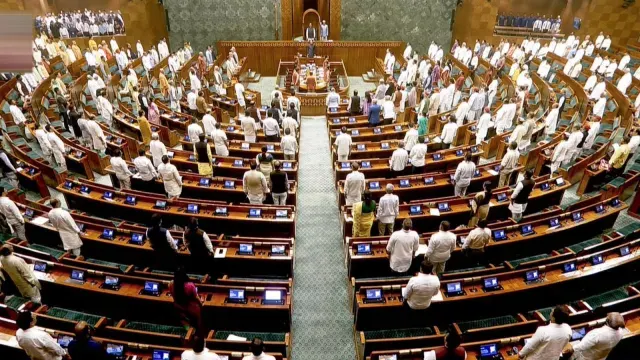
On the fourth day of the Jharkhand Assembly budget session on Saturday, Chief Minister Hemant Soren announced a major relief for Jharkhand Public Service Commission (JPSC) candidates. He also hinted at increasing the compensation amount for deaths due to elephant attacks and preparing a Standard Operating Procedure (SOP) to provide immediate assistance to affected families.
Chief Minister Soren announced in the House that the cutoff date for JPSC candidates has been fixed at August 1, 2022, whereas earlier it was fixed at 2026. After the Chief Minister's announcement, thousands of candidates who were earlier ineligible due to the fixed date will now get a chance to appear in the exam. However, student organizations were demanding to fix the cutoff date at August 2018.
Meanwhile, the state government has indicated a major decision in the case of deaths and damages due to elephant attacks in Jharkhand. Responding to a notice by Congress MLA Rameshwar Oraon, the Chief Minister said that the government is taking the issue seriously and a comprehensive SOP is being prepared. The Chief Minister stated that currently, in Jharkhand, there is a provision of Rs 4 lakh as compensation for death due to elephant attack, while in other states, the amount ranges from Rs 4 lakh to Rs 50 lakh. The government is studying the system of Assam, Odisha, and other states and will soon decide on increasing the compensation amount.
Mr. Soren said that in the new SOP, it will be ensured that the affected family receives the compensation amount within 10 days of the incident. Additionally, deaths due to other wild animals like tigers and snakes will also be included in the SOP. The Chief Minister also stated that if elephant menace is increasing in the Kanke area due to illegal mining, the government is keeping an eye on it and will take strict action against illegal mining. Earlier, MLA Tevari Mahato had alleged illegal mining in the Mando area using heavy machines.
In charge minister Sudeviya Sonu said that the government has not received any official information in this regard, but if a complaint is received, strict action will be taken. The issues of increasing the retirement age of government employees and backlog recruitment on a large scale were prominently discussed in the Assembly. The government clarified its stance on both issues, saying that currently, there is no proposal to increase the retirement age, while the process of filling backlog vacancies is ongoing on a priority basis.
Lok Janshakti Party (Ram Vilas) MLA from Chhatar, Jannardan Paswan, demanded an increase in the retirement age of employees. Paswan said that in Jharkhand, the retirement age of government employees and officers is 60 years, while in central services, the retirement age for doctors and teachers is 65 years. He also stated that in Jharkhand, doctors and university teachers are also retired at the age of 65. Paswan cited the example of neighboring state Chhattisgarh, where the retirement age has been increased to 62 years. He demanded consideration of increasing the age limit due to the shortage of manpower in the state.
In response, Finance Minister Radha Krishna Kishore clarified that every state takes decisions based on its geographical situation, financial resources, and administrative needs. He said that Chhattisgarh must have taken a decision based on its specific circumstances, but in Jharkhand, there is no such proposal under consideration at present. The Minister said that there are a large number of educated unemployed youths in the state, and the Hemant Soren government is making recruitments in an organized manner. If the retirement age is increased, opportunities for new recruitments will be limited, so the government's priority is to fill vacant posts with youths.
Congress MLA from Khijri, Rajesh Kachhap, raised the issue of backlog vacancies for Scheduled Tribes, Scheduled Castes, and other backward classes. He said that thousands of posts for reserved categories have been vacant for years and are not being filled properly in the recruitment process. He demanded a timely and clear policy for backlog recruitments. In response, the Minister said that the claim of over 50,000 backlog vacancies in various departments is not correct. He stated that the government is conducting department-wise recruitment processes and will fill backlog vacancies on a priority basis, following reservation rules. Instructions have also been issued to concerned departments to make the recruitment process more transparent and speedy.
According to the Economic Survey, the service sector is expected to grow. The service sector is expected to reach Rs 1,37,730 crore in 2025-26 and Rs 1,48,479 crore in 2026-27, indicating growth rates of 8.84% and 7.81%, respectively. Since the formation of the state, Jharkhand's budget has increased more than 20 times. In 2001-02, the budget was Rs 6,067 crore, which has increased to Rs 1,16,892 crore in 2024-25 (revised estimate) and Rs 1,45,400 crore in 2025-26. Total expenditure crossed the Rs 1 lakh crore mark for the first time in 2023-24. Fiscal discipline has been maintained in Jharkhand. Except for 2020-21, the fiscal deficit has remained within the 3% limit of the FRBM Act, although it reached 5.0% during the pandemic.
In Jharkhand, the banking infrastructure has increased to 3,449 branches and 3,338 ATMs by September 2025. 198 new bank branches have been established since December 2020. Between March 2014 and September 2025, deposits increased by 220% to Rs 3,79,735 crore, while credit increased by 124% to Rs 1,58,714 crore. The agriculture and allied activities sector is expected to contribute around 12.3% to the state's GSDP in 2025-26. During this period, the total agricultural GSDP increased by 34%, reaching around Rs 28,470 crore.
After the lunch break, the Assembly passed the third supplementary budget for 2025-26 through a voice vote. The related appropriation bill was also approved. Later, Assembly Speaker Ravindra Nath Mahato adjourned the House proceedings until 11 am on February 24. On February 24, the Jharkhand government will present its budget for the financial year 2026-27. The Economic Survey Report 2025-26 was presented in the Assembly today. Finance Minister Radha Krishna Kishore presented the Economic Survey Report, stating that Jharkhand's real GSDP has doubled between 2011-12 and 2024-25.
According to him, the state's GSDP at constant prices (2011-12) has increased from Rs 1,50,918 crore to Rs 3,03,178 crore. Jharkhand has performed better than the national growth rate for four out of seven years between 2018-19 and 2024-25, while in the pandemic year, it declined by 5.30% compared to a 5.8% decline at the national level. The Finance Minister said that the real GSDP is expected to reach Rs 3,21,892 crore in 2025-26 and Rs 3,41,064 crore in 2026-27, indicating growth rates of 6.17% and 5.96%, respectively. At current prices, the GSDP is expected to exceed Rs 5.6 lakh crore in 2025-26 and reach around Rs 6.1 lakh crore in 2026-27.
Finance Minister Radha Krishna Kishore stated that the per capita income at current prices has crossed the Rs 1 lakh mark for the first time, reaching Rs 1,16,663 in 2024-25. The real per capita income has increased to Rs 68,357, which is a 65.7% increase over 2011-12 and approximately 4.0% CAGR.
Related News
RSS decides to increase focus on youth and women
Awaz E Bihar
Government hiding truth on clash with China in Arunachal, country should be given full information: Kharge
Awaz E Bihar
Efforts to take the opposition into confidence regarding the women's reservation and delimitation bills
Awaz E Bihar