
National
 National
 National
 National
Kashmir: The Silent Hills of Zainapora Echoing with Buddhist History
Awaze Bihar3 min read
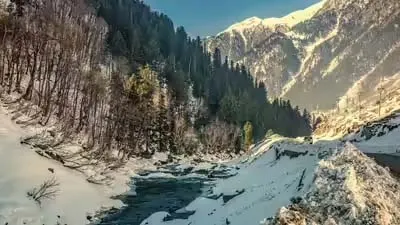
The serene hills of Zainpora, situated on the banks of the historic Srinagar-Jhelum Valley Road, may appear silent due to the winter season, but the story buried beneath them is louder than ever. According to archaeologists, the excavation conducted here has unearthed a Buddhist site that is nearly 2,000 years old and dates back to the Kushan era. This is the same discovery mentioned by Prime Minister Narendra Modi in his radio program 'Mann Ki Baat' in December. The first hint of this discovery came from a rare French archive photograph showing a glimpse of three stupas. The excavation will resume in April, and it is expected to reveal more secrets about the Buddhist past of the valley.
According to archaeologists, the Buddhist site discovered in the village of Zainpora in the Baramulla district of north Kashmir has been closed for excavation due to the winter season. However, the excavation will resume in April for a period of three months. Authorities have installed barbed wire to ensure the protection of the site and have also deployed police, as locals used to visit the area for recreation. During the excavation, artifacts from the Kushan era have been found, which provide clear evidence of Kashmir's ancient Buddhist past. The site is located near the Srinagar-Jhelum Valley Road, which was the only reliable connection between Kashmir and the outside world until the construction of the Jawahar Tunnel on the Srinagar-Jammu national highway in 1950.
Professor Muhammad Ajmal Shah, who is leading the excavation team, said that the excavation is being conducted in collaboration with the Department of Central Asian Studies and the Department of Archives, Archaeology, and Museums of the University of Kashmir. He described the discovery as one of the most significant archaeological findings in Kashmir in recent years. According to him, his team had been surveying the area for several years and was convinced that it was an extraordinary site based on the presence of three large mounds. Professor Shah said, "During a research fellowship in Paris in 2023, I got the opportunity to see old photographs of Kashmir taken by British tourists at a French museum."
He said, "In the archive photography section of the French museum, I found several old photographs of Kashmir, one of which showed the domes of Buddhist stupas, which I immediately recognized as the Zainpora site, where I had been visiting for years. Upon returning to Kashmir, we conducted further surveys and then sought formal permission from the government for excavation." He added, "Over the past century, there have been significant changes in the geographical structure of the area, which has also affected the size of the site." According to Professor Shah, the site was damaged during the construction of the Lower Jhelum Hydro Power Project canal in the 1970s and was divided into several parts. Locals reported that stone walls were also discovered during the construction of the canal.
The formal excavation of the site began last October when a memorandum of understanding (MoU) was signed between the University of Kashmir and the Department of Archives. During the excavation, a wall and a large hall have been discovered, indicating a major Buddhist settlement center of the Kushan era. According to Professor Shah, the discovery sheds light on the ancient Kashmiri era, which has not been extensively researched. He said that due to its location at the confluence of ancient trade routes, the site must have been an important spiritual and cultural center in the past.
Related News
RSS decides to increase focus on youth and women
Awaz E Bihar
Government hiding truth on clash with China in Arunachal, country should be given full information: Kharge
Awaz E Bihar
Efforts to take the opposition into confidence regarding the women's reservation and delimitation bills
Awaz E Bihar