
National
 National
 National
 National
Maulana Saghir Ahmed Rashadi and Dr. Muhammad Manzoor Aalam's services are unforgettable: Maulana Anisur Rehman Qasmi
Awaze Bihar8 min read
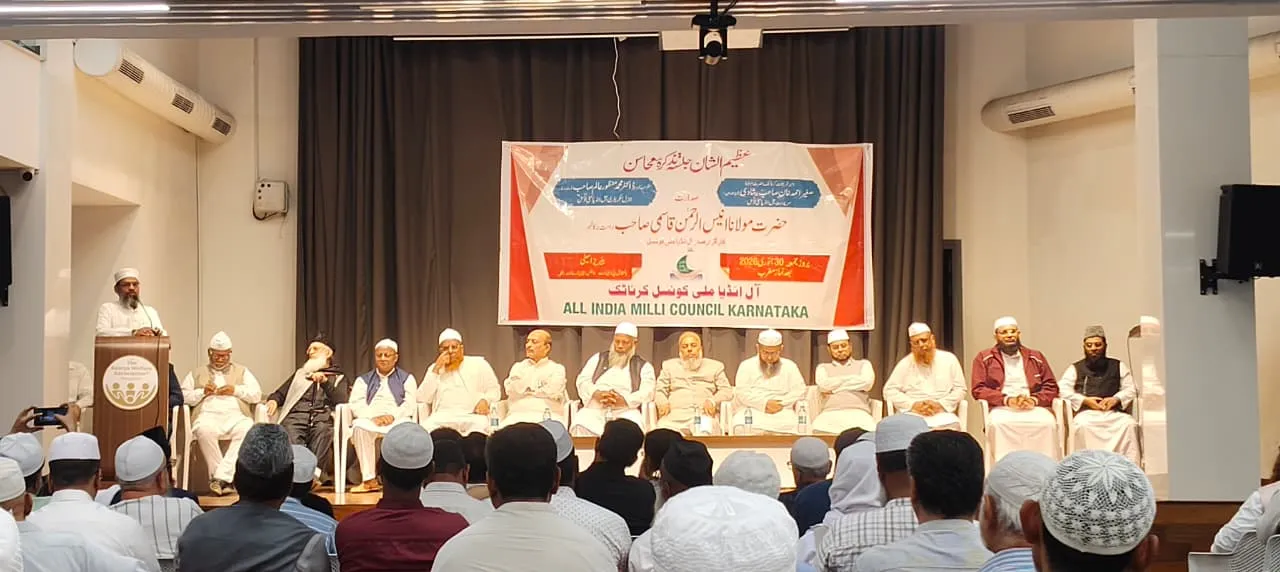
Under the aegis of the All India Milli Council, a condolence meeting was held in Bangalore, where thinker of the nation, Hazrat Maulana Anisur Rehman Qasmi, acting president of the All India Milli Council, delivered a heartfelt tribute to Hazrat Maulana Saghir Ahmed Rashadi, Amir-e-Shariat of Karnataka and Sheikh-ul-Hadith of Darul Uloom Sabilur Rashad, Bangalore, and Hazrat Dr. Muhammad Manzoor Alam, general secretary of the All India Milli Council, on their demise.
Maulana Qasmi said in his presidential address that death is an immutable reality of life, it is the completion of life. Every person has to pass through this path one day or the other. Perhaps there is hardly a day when someone's death news does not grieve and sadden us.
These are the hands of fate that have been entrusted with the task of
plucking flowers from the garden and leaving them in the wilderness
(Hyder Dehlvi)
But there are some personalities whose departure and death mourn the entire nation. Every person becomes deserving of condolence, who will condole whom, who will comfort whom, when every eye is tearful, every heart is grieved, and every individual is overwhelmed with sorrow. The two personalities we have gathered to remember and pay tribute to their achievements in today's condolence meeting, were also among those personalities of the nation who had dedicated their entire life and every moment of their life to the works of the nation.
The Prophet of Allah (peace be upon him) has said:
"Remember the good deeds of your deceased and forgive their mistakes."
This command is to see the life of our elders, understand and take lessons from their biography and determine the direction of action for ourselves, that how our elders guided the nation in what circumstances and how they made sacrifices for the sake of Allah's religion, ignoring the worldly concerns.
The life of Hazrat Maulana Saghir Ahmed Rashadi, Amir-e-Shariat of Karnataka and Sheikh-ul-Hadith of Darul Uloom Sabilur Rashad, Bangalore, and Hazrat Dr. Muhammad Manzoor Alam (may Allah have mercy on them) is a guiding light for those who love the nation and religion. By reading their lives, we can try to refine our lives. The leadership of the country and the nation provided by these two elders in adverse circumstances is a valuable asset of India's national history.
As you know, Hazrat Maulana Saghir Ahmed Rashadi, the rector of Darul Uloom Sabilur Rashad and Amir-e-Shariat of Karnataka (may Allah have mercy on him), was a unique example of simplicity, humility, sincerity, and piety, and was the guardian of the legacy of his elders. The sacrifices he made for the academic and constructive development of Jamia Sabilur Rashad, only Allah can reward him. Thousands of his students who are serving the religion are undoubtedly a part of his legacy. Similarly, all those who will benefit from this university till the Day of Judgment will also get the reward.
The steadfastness and firmness of Hazrat Amir-e-Shariat (may Allah have mercy on him) in religious sciences and works is that he spent his entire life in Darul Uloom Sabilur Rashad, Bangalore. He received his initial education and the honor of memorizing the Holy Quran here. He completed his formal education here, started his teaching career here, and here he savored the cup of knowledge of Hadith and Tafseer and was buried in its soil. He was in love with Darul Uloom Sabilur Rashad and its founder Hazrat Maulana Abul Sa'ud Sahib; but it is not that he had confined himself to the four walls of this educational institution; rather, when needed, he came out of the four walls of this institution and led the nation in the open field.
His tenure as Amir-e-Shariat of Karnataka is not only a matter of pride for the state but also for the entire Indian Muslim nation. The tolerance, good governance, and faith-based insight with which he guided the nation religiously, nationally, and intellectually as Amir-e-Shariat are worthy of emulation for every leader. Similarly, the notable works he has done as a member of the All India Muslim Personal Law Board and as a patron of the All India Milli Council will, God willing, always be remembered.
The intellectual vacuum created in the country, especially in South India, due to the death of Hazrat Maulana (may Allah have mercy on him), may Allah fill it with His special grace.
Similarly, another important personality who left us this year and this month is Dr. Muhammad Manzoor Alam (may Allah have mercy on him). The truth is that among the important personalities who have influenced India's academic and social society with their academic heritage and academic works and changed the trend and thinking of the elite, Dr. Muhammad Manzoor Alam's personality is prominent.
I had the first meeting with him probably in 1987 at the Imarat-e-Shariah, and then with Hazrat Maulana Qazi Mujahidul Islam Qasmi (may Allah have mercy on him) in Delhi. In 1981, Hazrat Qazi Sahib (may Allah have mercy on him) had organized a scholarly discussion on some important modern issues such as euthanasia, etc. under the aegis of the Center for Research and Studies, in Phulwari Sharif, Patna, in which I also got the opportunity to participate as a helper.
Until then, there was no general trend of collective thinking and deliberation among the class of scholars on new emerging issues; although it was decided among the senior scholars that despite the change in circumstances and time, Islamic jurisprudence has the permanent ability to solve new situations and problems. To popularize this thought, in 1987, a quarterly discussion and research journal was launched under the editorship of Hazrat Maulana Qazi Mujahidul Islam Qasmi (may Allah have mercy on him). I was the deputy editor of this journal. This journal motivated scholars and muftis to write articles on various academic and intellectual topics, especially on issues that were the product of modern circumstances, science, and technology, and were affecting modern society.
At that time, there was a need for positive and argued research and answers to solve new emerging problems and to reform deviant and atheist-minded writers, which this journal was doing. Dr. Muhammad Manzoor Alam was also one of the important contributors to this journal, and he wanted to take this thought further. Therefore, in 1989, Dr. Sahib suggested organizing a large-scale seminar in Delhi under the aegis of the Center for Research and Studies; then, with his cooperation, a national-level seminar was organized at Jamia Hamdard, New Delhi, on topics like birth control, organ transplantation, and hijab, in which important religious and academic personalities of the country participated.
Before that, in 1986, Dr. Muhammad Manzoor Alam had founded the Institute of Objective Studies, whose objectives included assessing the situation of Muslims in India, recovering Islamic heritage, and preparing for the future, and this juristic work was also a part of the bright future. For this thought, he gathered teachers, writers, lawyers, journalists, and politicians from universities and madrasas of India and the Islamic world, and involved them in academic and research work through language and pen.
Dr. Sahib had established other institutions besides I.O.S for various tasks and worked on different fronts through them. Basically, he was interested in highlighting the true thought of Islam and the scientific and intellectual services of Muslims, and for this, he included modern and ancient individuals from different schools of thought, which was reflected in the academic assemblies and discussions of more than twelve hundred seminars he organized across the country through I.O.S. I also got the opportunity to participate in many of its seminars.
I saw that Dr. Sahib used to present very thought-provoking things related to the subject of every seminar. On the other hand, due to his health weakness for a few years, he was less participatory. In Patna, a seminar was held on the topic of "Ijtihad", and another on the thoughts and life of Maulana Manazir Ahsan Gilani. The title of "Ijtihad" makes it clear that the challenge of changing circumstances and life can only be faced through collective ijtihad, and the well-being and guidance of Islam can only be presented in the form of a living and dynamic law.
This thought motivated Hazrat Maulana Qazi Mujahidul Islam Qasmi (may Allah have mercy on him) and Dr. Muhammad Manzoor Alam (may Allah have mercy on him) to work together, and then the Islamic Fiqh Academy (India) was established, whose objectives included finding solutions to modern emerging problems and changing circumstances through collective research in the light of juristic principles, and to convey the fatwas and research of reputable religious institutions and scholars across the country and abroad to the people, and to benefit from the academic treasure of different schools of thought, so that the misconceptions about Islamic laws can be removed, and the new problems arising in the fields of economy, society, custom, and civilization can be solved and presented to the people.
The academy has worked on this plan and has provided notable services. Undoubtedly, the Islamic Fiqh Academy has done notable services in its academic journey, which also includes the efforts of Dr. Muhammad Manzoor Alam. I.O.S and Islamic Fiqh Academy have prepared a team of capable scholars and intellectuals who are the future of the nation and are doing better work. This is the result of Dr
Related News
RSS decides to increase focus on youth and women
Awaz E Bihar
Government hiding truth on clash with China in Arunachal, country should be given full information: Kharge
Awaz E Bihar
Efforts to take the opposition into confidence regarding the women's reservation and delimitation bills
Awaz E Bihar