National National
 National
 National
Urdu and its writers have also influenced other languages and cultures: Imtiaz Hasanain
Awaze Bihar5 min read
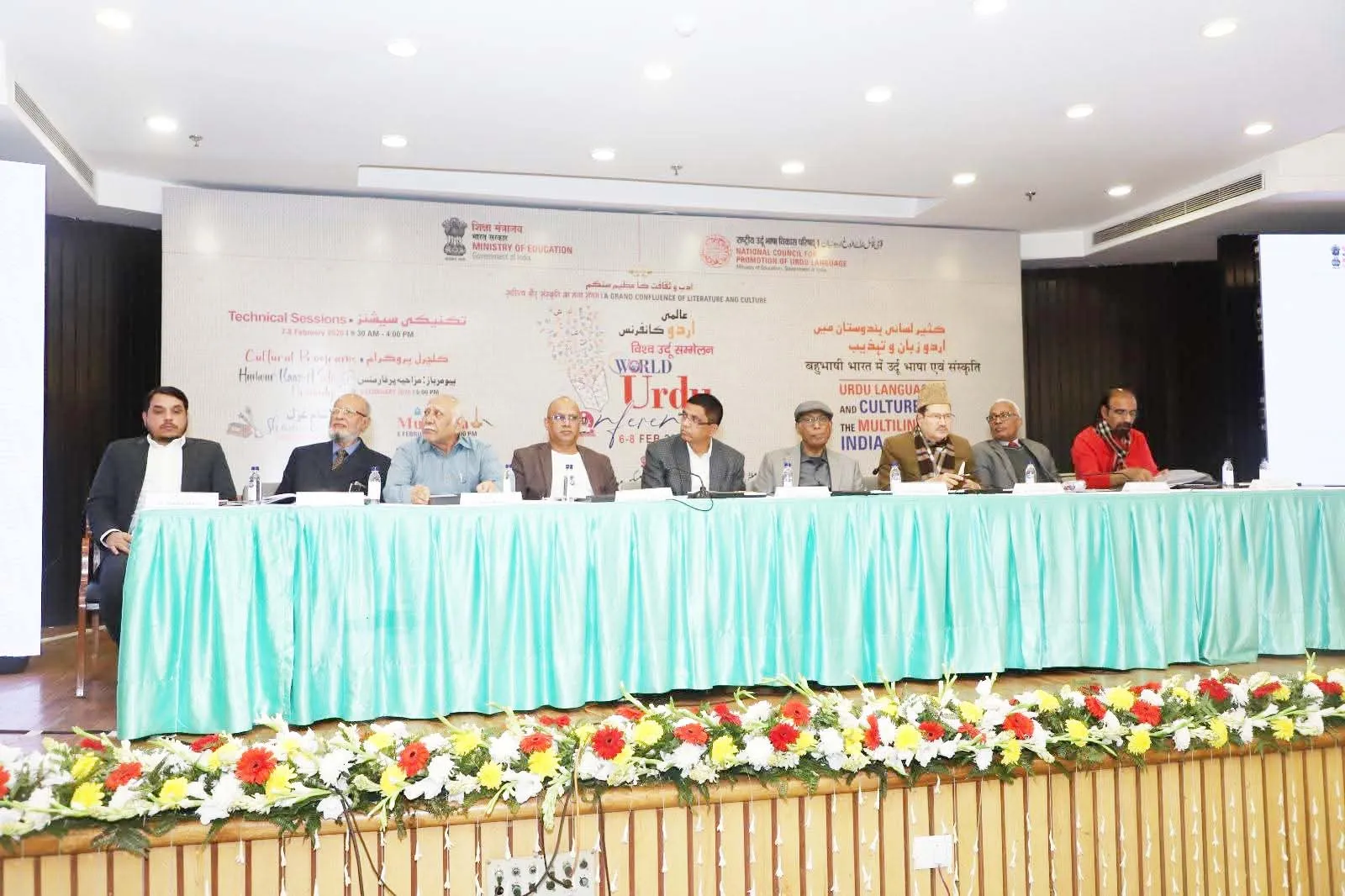
The National Council for Promotion of Urdu Language organized a global Urdu conference titled 'Urdu language and culture in multilingual India' today, with three technical sessions.
Professor Imtiaz Hussain said in his presidential address that passion has made Urdu a cosmopolitan language. Urdu has had an impact on other languages and its writers have also influenced other languages and cultures. Especially, Shibli's 'Shair-ul-Ajam' and Syed Suleman Nadvi's writings have had a profound impact. He expressed happiness while discussing all the papers of the session and emphasized the importance of translation, calling it a vital need of the present time. Professor Chandrashekhar discussed the relationship between language and literature in his presidential address. He said that a public language is not popular because of literature. A language remains alive in its form wherever it goes. For example, an Indian laborer going to another country uses his mother tongue in his everyday conversation. Regarding Urdu, he said that as long as the speakers of this language, belonging to any religion, exist, the language will remain alive. Respected Janaki Prasad Sharma discussed 'Urdu and Hindi: mutual influence and impact', saying that no language's script is complete in itself. He discussed the relationships between languages with arguments. About Urdu and Hindi languages, he said that they have incorporated each other's words in large numbers into their languages.
Professor Muhammad Qutbuddin discussed the topic 'The role of translations in the expansion and dissemination of Urdu language and literature', referring to the translations of Arabic literature, saying that it has greatly strengthened the style and phrases of the Urdu language. The words and phrases that came from Arabic have become very popular in Urdu. Professor Rizwan Ahmed discussed the 'Status of Urdu's impact on regional languages in Qatar', saying that India and Arab countries have beneficial things to say about the use of prevalent words in culture, civilization, and everyday conversation. K.P. Shamsuddin presented a thought-provoking paper on 'Urdu language and literature in Kerala'. Firoz Ahmed presented a paper on 'The impact of Urdu language and literature on regional languages in Ladakh'.
The second technical session was chaired by Professor Muzaffar Ali Shahmiri. Professor Muzaffar Ali Shahmiri, while presenting his presidential address, discussed all the papers of the paper presenters in detail. He said that in the present era, civilization is actually understood through technology and machines. Professor Ahmed Mahfuz discussed the topic 'The impact of Persian on classical Urdu poetry', saying that although Persian is very different from Urdu, the two have a very close relationship in terms of classical and literary civilization. Professor Akhlaq Ahmed Ahan discussed the topic 'The literary and cultural relationship between Persian and Urdu in multilingual India', saying that the effects of Persian can be seen in other languages in India as well. Professor Vibha Sharma said that Urdu, like English, is an inclusive language and can only be compared to English. Dr. Naseem Ahmed Naseem discussed the relationship between Urdu and Bhojpuri. Respected Mamiyakinsa from Japan discussed the relationship between Urdu and Hindi, saying that he has learned not only Urdu but also Hindi in Japan.
He also presented important points regarding the script in his paper.
The president of the third session, Professor Anisur Rehman, pointed out important points while discussing the papers of the paper presenters. He said that setting the parameters of comparative studies is a fundamental task. It is also necessary to understand here that the comparative study is being done of language or dialect. In my opinion, we set parameters through language. He said that it is also very important to theorize while translating.
The first guest of honor, Firoz Bakht Ahmed, said that many people call Urdu the language of religion and culture, which is not appropriate in his opinion; Urdu belongs to everyone. The second guest of honor, Professor Farooq Ansaari, said that translation is a difficult task compared to creation and is necessary. Translation is playing an important role in the promotion and dissemination of Urdu. Dr. Mahir Mansoor presented a paper on 'A glance at the mutual translations of Kannada and Urdu languages', saying that the Kannada language has borrowed a lot from Urdu and Persian, although fewer translations have been done from Urdu to Kannada. More translations are needed to expand the relationship between Kannada and Urdu. Aslam Mirza discussed the topic 'The role of translations in the expansion and dissemination of Urdu language and literature', saying that translations from various languages have a significant contribution to making Urdu rich. He cited the example of Fort William College in this regard.
Dr. Shafqat Sopori discussed the 'Aesthetic, cultural, literary, and linguistic impact of Urdu on the Kashmiri language', saying that grammar plays a vital role in keeping languages alive. We accepted the words of Urdu that were in accordance with national aesthetics and rejected those that were against it. This reflects the sonic quality of the language. Professor Ahmed Abdul Rehman Al-Qadri discussed the 'Role of translation in the education of Indian languages and the formation of Arabic awareness in Egypt', saying that whenever there was a need for Arabs and Indians to understand each other and feel emotions, translations played a vital role. Urdu has also been included in the curriculum of some universities in Egypt. Dr. Asif Ali Memon presented his paper on the topic 'The impact of Urdu on various languages spoken in Mauritius', saying that migrants have played an important role in the promotion of Urdu in Mauritius, including Uttar Pradesh, Bihar, Maharashtra, and some parts of the Deccan. Dr. Amanullah M.B. presented his paper on the topic 'Tamil and Urdu: linguistic and literary comparison, thoughts, and mutual sharing', saying that Urdu and Tamil have a very old relationship, thanks to the Deccan, and the grammar of both languages is almost similar.
After the technical sessions, a grand cultural event titled 'Sham Ghazal' was organized at the M.A. Ansari Auditorium (Jamia Millia Islamia, New Delhi), in which renowned ghazal singer Rajesh Singh, along with his companions, entertained the audience with various ghazals and songs. Dr. Faiyazul Haq introduced the program and welcomed the guests. On this occasion, a large number of audiences, including guests from the country and abroad, officials, members, and staff of the council, were present.
Related News
RSS decides to increase focus on youth and women
Awaz E Bihar
Government hiding truth on clash with China in Arunachal, country should be given full information: Kharge
Awaz E Bihar
Efforts to take the opposition into confidence regarding the women's reservation and delimitation bills
Awaz E Bihar