National National
 National
 National
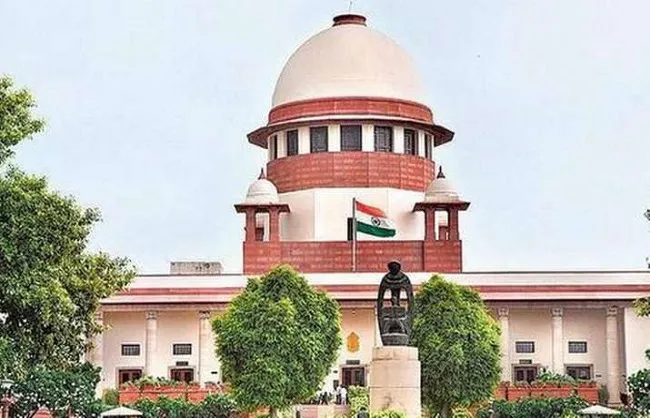
Supreme Court reserves verdict on pleas seeking comprehensive guidelines to curb hate speeches
Awaze Bihar3 min read
The Supreme Court on Tuesday reserved its order on pleas seeking effective action against incidents of hate speeches across the country. A bench comprising Justices Vikram Nath and Sanjeev Khanna directed all parties to file brief written submissions within two weeks after hearing the pleas.
The hearing on the pleas is being held in the backdrop of the court's earlier directions that whenever a speech or act amounts to a crime under Sections 153A, 153B, 295A, and 505 of the Indian Penal Code, authorities should take suo motu action and register cases against the culprits, and not wait for a formal complaint.
Senior advocates Siddharth Agarwal, MR Shamshad, Sanjay Parikh, Sanjay Hegde, and advocate Nizam Pasha appeared for the petitioners, while Additional Solicitor General SV Raju and senior advocate DS Naidu represented the respondents. Advocate Nizam Pasha, appearing for several petitioners, submitted that there is a consistent hesitation on the part of law enforcement agencies to take action against hate speech incidents, particularly when the accused belong to the ruling parties.
He argued that the problem is not the absence of legal provisions but their ineffective enforcement. Despite repeated directions from the court, "usual suspects" continue to make inflammatory speeches, arrests are not made after an FIR is lodged, and authorities fail to take action, even when incidents of hate speech are publicized beforehand with clear indicators of hate speech, but no action is taken.
The petitioners also highlighted the emerging nature of hate speech in the digital age. Senior advocate Siddharth Agarwal referred to a petition which mentioned a video allegedly using a communal narrative for political purposes, created by AI. He also expressed concern over the refusal to register an FIR in cases of hate speech, which require government sanction. While sanction is required at the stage of cognizance, it is not a condition for registering an FIR or starting an investigation.
Senior advocate Sanjay Hegde pointed out how hate speech now follows a life cycle, starting with a slogan or phrase, spreading through social media, and eventually becoming mainstream through the media. He cited examples such as the "UPSC Jihad" broadcasts and appealed to the court to consider ways to make hate speech unprofitable for large corporations and digital platforms.
Senior advocate MR Shamshad and advocate Amit Pai also submitted that police authorities often wrongly insist on prior government sanction to register an FIR. They pointed out that while sanction may be required at the stage of cognizance, it is not a condition for registering an FIR.
Appearing for the People's Union for Civil Liberties (PUCL), senior advocate Sanjay Parikh argued that the focus should be on strengthening and amending the guidelines issued in the Tehseen Poonawalla versus Union of India case to more effectively eliminate incidents of hate speech. A petition was also filed stating that hate speech should be considered a "constitutional tort" that violates the fundamental rights of marginalized communities, which can be remedied outside of criminal law remedies.
Responding on behalf of the central government, Additional Solicitor General SV Raju stated that the court's directions have been substantially complied with. He said that in most cases, FIRs have been registered, while in other cases, the inquiry did not reveal any criminal offense.
The Supreme Court, reserving its order on the pleas, clarified that one case, Kazim Ahmed Shirwani versus State of Uttar Pradesh and others, related to an alleged hate speech against a Muslim cleric in Noida, would be heard separately at a later stage.
The Supreme Court directed all parties to file brief written submissions within two weeks. In November 2023, the Government of India filed a status report stating that 28 states and Union territories have appointed nodal officers in compliance with the guidelines issued in the Tehseen Poonawalla case.
The Supreme Court has earlier clarified that it does not intend to legislate or monitor every individual incident of hate speech. The legal mechanism, police authorities, and high courts are in place. The court has stated that its role is limited to ensuring an effective enforcement framework, which allows complaints to be addressed by the appropriate high courts.
Related News
RSS decides to increase focus on youth and women
Awaz E Bihar
Government hiding truth on clash with China in Arunachal, country should be given full information: Kharge
Awaz E Bihar
Efforts to take the opposition into confidence regarding the women's reservation and delimitation bills
Awaz E Bihar