Artificial Intelligence in the Classroom: What Happens When Technology Teaches the Wrong Lesson
Awaze Bihar5 min read
Dr. Riaz Ahmed UAE
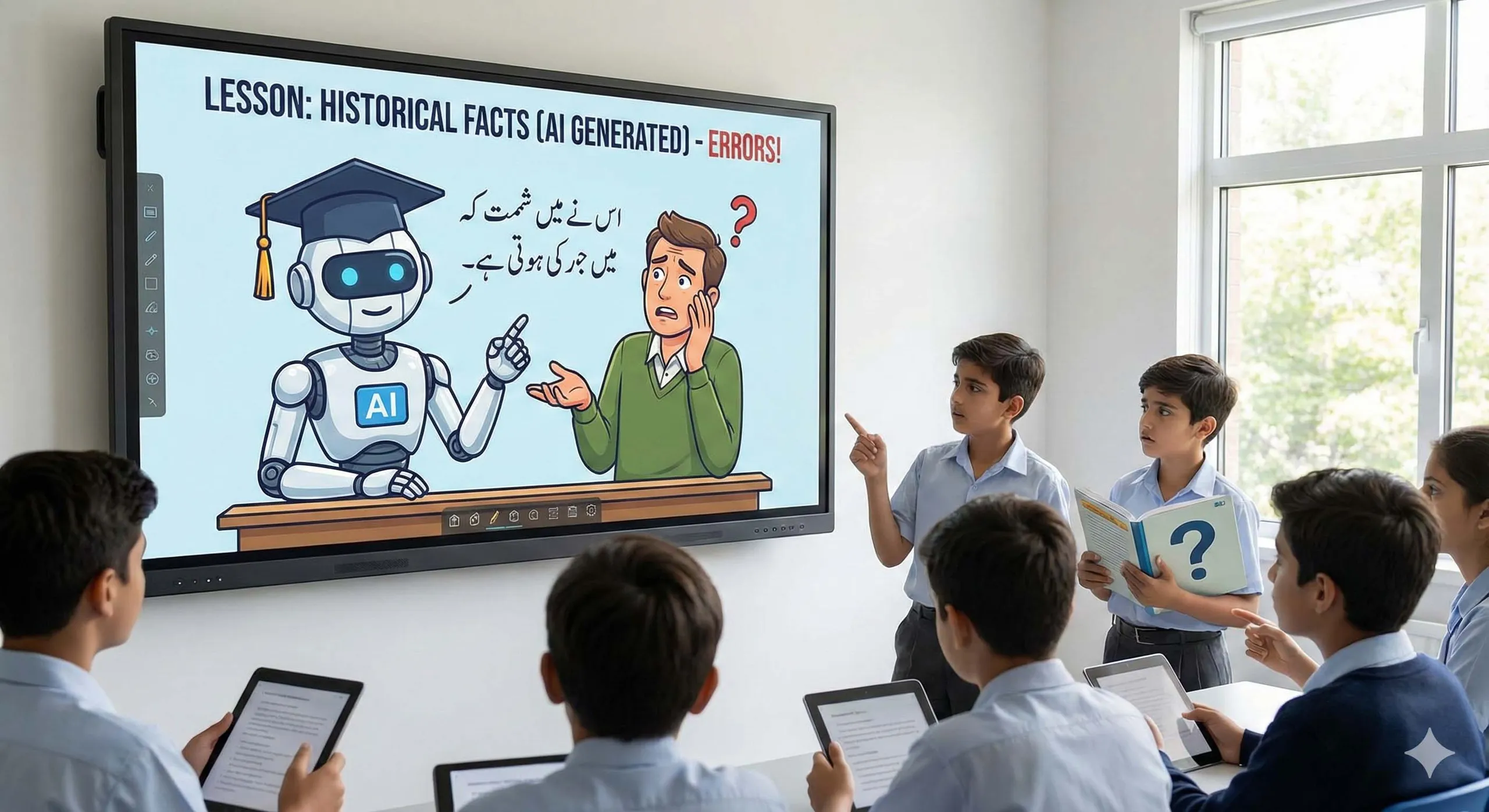
Artificial intelligence is no longer a distant or experimental thing in the field of education. It has quietly reached the teachers' desks and laptops, where it is being used to prepare lectures, simplify complex concepts, summarize subjects, and arrange exam questions. From school rooms to university lecture halls, AI-based tools are being adopted rapidly. However, with this rapid change, a very important question arises: what if the information obtained from artificial intelligence is incorrect and the same mistake is taught to students?
The appeal of artificial intelligence in education is quite clear. A time-pressed teacher can obtain an explanation of a difficult mathematical concept, a summary of historical events, or ideal examples in a matter of moments. Artificial intelligence presents the material with fluency and confidence, but this fluency is also its greatest weakness. The system does not "know" like human understanding, but rather creates answers based on language patterns, and in this process, it sometimes presents incorrect or misleading information with great confidence.
For example, a teacher uses artificial intelligence to explain the concept of limits in mathematics. The answer appears to be correct and impressive, but it misrepresents a fundamental condition. Students, due to the teacher's authority and confidence, memorize this incorrect explanation. This mistake does not appear immediately but manifests months later in the form of confusion and lack of understanding in higher-level education. At this stage, rectifying the damage becomes much more difficult.
The risks can be even more severe in history and social sciences. Artificial intelligence sometimes oversimplifies complex historical events, misconnects causes, or repeats biased narratives. A lesson prepared on colonial history might ignore a crucial point of view or distort the timeline. When such information is presented in the classroom, it gains the status of truth due to institutional authority.
The core of this entire issue is accountability and responsibility. Despite the increasing role of technology, the responsibility for knowledge has not shifted from humans to machines. The teacher is still the ultimate guardian of academic accuracy. If incorrect information reaches students, the fault may lie in the technology, but the responsibility will still be considered professional.
This principle is not new. Teachers have always been bound to verify sources, whether they are textbooks, reference books, or online material. Artificial intelligence does not exempt this responsibility. Using artificial intelligence without verification is like teaching from an outdated or unreliable book. The source is new, but the duty remains the same.
The effects of incorrect information are not limited to a single lesson. Conceptual errors in subjects like mathematics and science can affect the learning process for years. In professional education, these errors can impact practical skills. The greatest harm is the erosion of trust. Students rely on their teachers not only for guidance but also for accurate knowledge. When this trust is injured, the educational relationship weakens.
Another subtle but dangerous aspect is that over-reliance on artificial intelligence can weaken critical thinking. If teachers accept material from artificial intelligence without question, students will also adopt this approach. Thus, education will be limited to the use of information rather than research and analysis.
However, it is neither possible nor wise to completely reject artificial intelligence. Used responsibly, it can improve teaching, provide multiple explanations for different learners, create practice questions, and make language more understandable. The problem lies not in the use but in the uncritical use.
Many educational institutions are now recognizing the need for clear guidelines. Material obtained from artificial intelligence should be considered a preliminary draft, not the final authority. Verification with standard textbooks, research papers, and credible reference materials must become routine, especially in subjects where accuracy is paramount.
Teacher training is equally essential. They should be made aware not only of how to use the tools but also of their limitations, biases, and potential errors. Without this understanding, artificial intelligence can cause harm despite good intentions.
Transparency is also an effective safeguard. When a teacher openly states that the material was prepared with the help of artificial intelligence and then verified, they set an example of responsible behavior. This also encourages critical thinking among students.
Mistakes, if they occur, are not necessarily disastrous. Timely acknowledgment and correction strengthen academic integrity. A teacher who admits their mistake teaches students that truth is more important than ego.
Institutions also have a significant responsibility. Schools and universities should develop clear policies on the acceptable use of artificial intelligence, verification principles, and accountability procedures. Leaving it to individual discretion can lead to uneven practices and misuse.
Ultimately, the question of artificial intelligence in education is not about replacing teachers. The real question is whether this technology will strengthen good teaching practices or exacerbate their weaknesses. Artificial intelligence can improve explanation, pace, and accessibility, but without understanding, it can also spread error on a large scale.
Education has always been based on human responsibility. Long before artificial intelligence, teachers decided what to teach, how to teach, and which questions to raise. These decisions shape minds and futures. No algorithm can replace this ethical and professional responsibility.
As classrooms adapt to this new technology, the question is no longer whether artificial intelligence will be used. It is being used. The real question is whether we can combine innovation with wisdom, verification, and accountability. The answer will determine whether artificial intelligence becomes an aid to education or silently introduces ambiguity in the guise of knowledge.