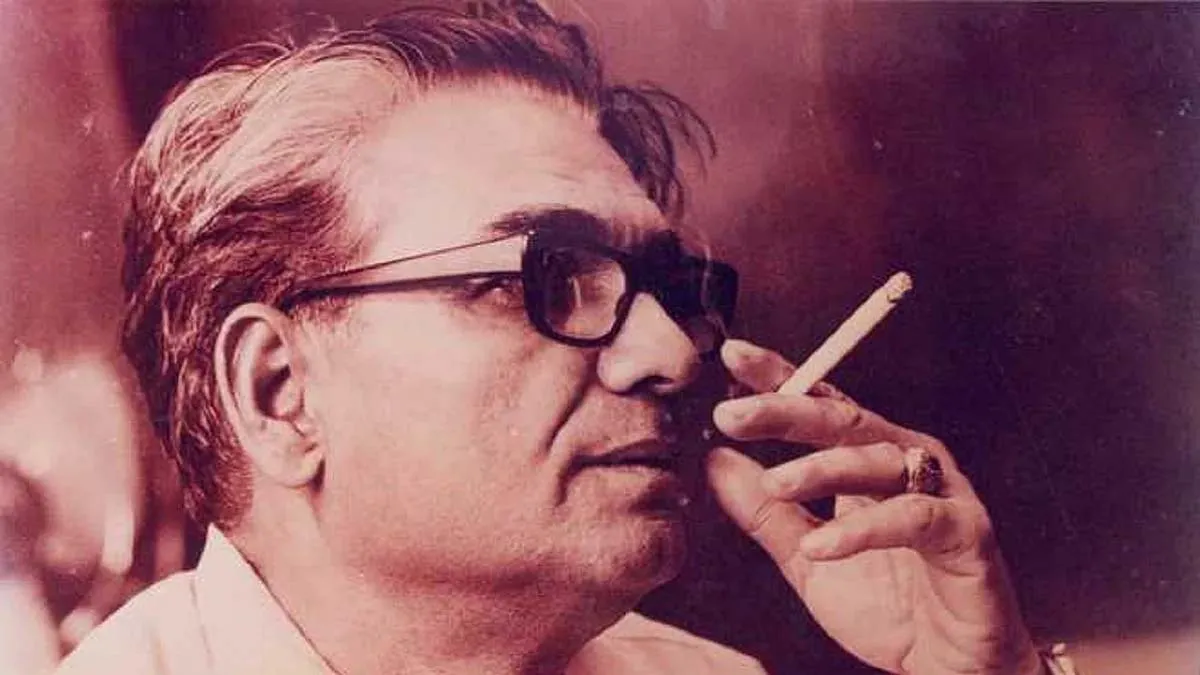
Filmmaker and Director Kamal Amrohi as a Writer
Awaze Bihar7 min read
The moment Kamal Amrohi's name comes to mind, the thought of the film 'Pakeezah' inevitably follows. Although he made other films as well, this masterpiece was Kamal Amrohi's dream project. Due to its exceptional dialogue, music, and Meena Kumari's unparalleled acting, the film left an indelible mark on the hearts and minds of the audience, which remains unerasable to this day. The songs of this film are so captivating that even today, when the songs of 'Pakeezah' are heard somewhere, people's heartbeats stop, and they become all ears. Although all the songs of the film are liked, one of its songs, 'Mausam Hai Aashiqana... Ae Dil Kahan Se Unko Dhoondh Lana', became extremely popular. The film's music, which touched the heartstrings, and the binding of words led to its success, breaking all records. Today, this film is considered one of the classics of Bollywood.
'Pakeezah' was Kamal Amrohi's dream project, which he started working on in 1958. This was the era of black and white films, and this film was also to be made in black and white. However, after some time, when CinemaScope became popular in India, he started making it in CinemaScope in 1961.
Kamal Amrohi was born on January 17, 1918, in the Amroha district of Uttar Pradesh. The incident of his entry into the film industry is also quite interesting. It is said that he was extremely mischievous in his childhood and used to trouble the entire village with his pranks. Once, when his mother scolded him severely, he promised his mother that one day he would become one of the most popular people and fill her lap with gold and silver coins. Meanwhile, an incident occurred that changed the course of his life. His elder brother, tired of his mischievousness, thrashed him. Enraged, Kamal Amrohi left home and ran away to Lahore.
Lahore changed the direction of his life. He decided to become a big man. He worked hard and earned a master's degree in Oriental Languages. He was extremely intelligent, which can be gauged from the fact that at the age of just 18, he started writing columns in an Urdu newspaper. The editor of the newspaper was so impressed with his abilities that he fixed a monthly salary of 300 rupees for him, which was a substantial amount at that time. After working for the newspaper for some time, he became disillusioned with the job and moved to Calcutta and then to Bombay.
In Lahore, Kamal Amrohi met the famous singer and actor K.L. Saigal. Impressed by Kamal Amrohi's abilities, Saigal took him to Bombay to introduce him to Sohrab Modi. Here, he struggled to make a place for himself in the film industry. During this period, he met Khwaja Ahmad Abbas. Abbas was so impressed with one of Kamal Amrohi's stories that he decided to make a film based on it and even found a producer for it. However, after this, Kamal Amrohi faced financial difficulties. He had no money to eat or a place to live. His stars were not in his favor. Meanwhile, he received news that Sohrab Modi was looking for a new and unique story. He immediately went to Modi and was hired at a monthly salary of 300 rupees. His story-based film 'Pukar' (1939) became a super hit, starring Naseem Banu and Chandramohan. He wrote four songs for this film. After the success of this film, Kamal Amrohi's magic worked in films, and he wrote stories, scripts, and dialogues for many films.
The film 'Mahal' proved to be a significant turning point in Kamal Amrohi's career. This film was full of suspense and romance. Film producer Ashok Kumar entrusted Kamal Amrohi with the direction of the film. Due to its excellent songs and music, the film became a super hit, and since then, suspense has become a trend in films. The film's massive success gave Madhubala and Lata Mangeshkar a new identity. Encouraged by this, Kamal Amrohi established Kamal Pictures in 1953 and Kamalistan Studio in 1958. Under his banner, he made an art film 'Daera' with his wife Meena Kumari, but it was not successful.
Kamal Amrohi's lineage is connected to the spiritual and mystical saint Syed al-Arefin Syed Hussein Sharfuddin Shah Wilayat, who is a descendant of Imam Ali. Shah Wilayat was also a great saint. The greatness of his shrine is that even today, no scorpion stings within its premises. Kamal Amrohi's family has been a family of scholars, theologians, and poets. His great-grandfather, Amir Hasan Amir, was a poet who wrote in various genres, including ghazal, salam, marsiya, naat, qasida, and rubai. Amir Hasan Amir translated the Persian book 'Rawzat al-Shohada' by Mulla Waiz Hussein Kashifi into Urdu under the title 'Baran-e-Gham'. This translation has the distinction of being a poetic translation of the poetic part and a prose translation of the prose part.
Kamal Amrohi was born on January 17, 1917, in Amroha. Before entering the film world, Kamal Amrohi had already gained nationwide recognition as a writer and journalist. Five of his books were published, including two collections of short stories, 'Pardesi' and 'Hazaar Dastaan'. He also wrote a novel called 'Yadon Ka Mandir' and translated an Arabic novel into Urdu under the title 'Motiyon Ka Darakht'. Kamal Amrohi also translated the English novel 'Romeo and Juliet' into Urdu. During his stay in Lahore, Kamal Amrohi met many notable writers of the time, including Saadat Hasan Manto, Rajinder Singh Bedi, Ahmad Nadeem Qasmi, and Khwaja Ahmad Abbas. Abbas had also translated one of Kamal Amrohi's stories into English.
Before entering the film world, Kamal Amrohi had already made a name for himself as a writer and journalist. He edited the literary magazine 'Taj' published from Lahore and also edited the magazine 'Saqi' published from Delhi. Through 'Taj' and 'Saqi', Kamal Amrohi showcased his mastery of the pen in literary journalism. Kamal Amrohi also served as the editor of a notable digest, 'Khulasa-e-Sarf-o-Nahw', through which enthusiasts learned standard Urdu and language points. This digest was a favorite among notable writers of its time.
Kamal Amrohi's style of writing can be enjoyed by watching the film 'Mughal-e-Azam'. The film begins with the following words, each of which exudes the fragrance of love for one's country: "I am Hindustan, the Himalayas are the guardians of my borders, the Ganges is the witness of my purity, and I have been a companion of darkness and light since the beginning of history."
As for Kamal Amrohi's poetry, it has the same flavor that has been the hallmark of the poets of his family. The language of Kamal Amrohi is similar to that of his cousins, Rais Amrohi and Jaun Elia. For example, consider the melody of his ghazal:
"Saz-e-dil, naghma-e-jaan, rooh-fiza hai kya hai?
Tu kiran hai ke shafaq hai ke saba hai kya hai?
Piyaas ki aag bujha di hai teri qurbat ne
Tu samandar hai ke darya hai ke ghata hai kya hai?
Teri aankhon mein kayi rang jhalakte dekhe
Sadaagi hai ke jhijhak hai ke haya hai kya hai?
Naam honton pe tera aaye to taskeen mile
Rahat-e-jaan hai, dilaasa hai, dua hai kya hai?"
Kamal Amrohi wrote stories, dialogues, and scripts for the films 'Jailer' (1938), 'Hari' (1940), 'Bhroosa' (1940), 'Mazak' (1943), 'Phool' (1945), 'Shahjahan' (1946), 'Mahal' (1949), 'Daera' (1953), 'Dil Apna Aur Preet Parai' (1960), 'Mughal-e-Azam' (1960), 'Pakeezah' (1971), 'Shankar Hussain' (1971), and 'Razia Sultan' (1983). It is true that he did not work on a large number of films, but in the select few films he worked on, he worked with complete dedication and passion. It is true that his pace of work was very slow, which was also criticized. Hema Malini also criticized him for the slow pace of 'Razia Sultan'. However, his work reflected his personality.
As mentioned earlier, 'Pakeezah' was Kamal Amrohi's dream project,